Case Laws

The first 24 hours after a driving charge are the most critical for your defence.
Don’t let a single mistake define your life.

Speak With a Criminal Defence Lawyer

R. v. Graat (1982 SCC)

R. v. Graat (1982 SCC) explains when a police officer can give opinion evidence in court. The Supreme Court confirmed that an officer can give an opinion about impairment based on observations, even if they are not called as an expert witness.

Read More »

R. v. Binnington (1975 SCC)

R. v. Binnington (1975 SCC) explains that the Crown must prove real control over a vehicle before someone can be convicted of a driving-related offence. The Supreme Court made clear that courts must carefully examine the facts before deciding that a person had care or control.

Read More »

R. v. Wren (2000 ONCA)

R. v. Wren (2000 ONCA) explains that the Crown must prove a real risk of danger before someone can be convicted of a driving-related offence. The Ontario Court of Appeal confirmed that just being inside a vehicle is not automatically enough to prove guilt.

Read More »

R. v. Toews (1985 SCC)

Supreme Court clarifies that the Crown must prove a realistic risk of danger before convicting in certain driving-related offences. R. v. Whyte (1988 SCC) confirms that simply being in the driver’s seat does not automatically mean a crime has been committed.

Read More »

R. v. Appleby (1972 SCC)

How circumstantial evidence can be used to prove elements of a criminal offence. R. v. Appleby (1972 SCC) is important in driving-related cases because it shows how courts assess indirect evidence and draw reasonable inferences.

Read More »

R. v. Whyte (1988 SCC)

How reverse onus provisions work in criminal law and how presumptions can affect proof. R. v. Whyte (1988 SCC) is important in driving-related criminal cases because it deals with when the burden shifts to the accused and whether that shift is constitutional.

Read More »

R. v. Partridge (2009 ONCA)

How courts determine whether a driver truly refused a lawful breath demand. R. v. Partridge (2009 ONCA) is important in refusing a roadside breathalyzer charges because it focuses on what counts as a refusal and how intent is proven.

Read More »

R. v. Moore (2012 ONCA)

Ontario Court of Appeal explains how courts decide whether a driver truly refused a breath demand. R. v. Moore (2012 ONCA) is important in refusing a roadside breathalyzer charges because it focuses on whether the demand was clear and whether the refusal was intentional.

Read More »

R. v. Thomsen (1988 SCC)

Supreme Court confirms that police may demand a roadside breath sample before allowing a driver to speak to a lawyer. R. v. Thomsen (1988 SCC) is one of the earliest cases explaining how the right to counsel works during roadside breath testing.

Read More »

R. v. Orbanski (2005 SCC 37)

Supreme Court explains when police can demand a roadside breath test before letting a driver call a lawyer. This case is very important in refuse roadside breathalyzer charges because it sets the rules for what police must do during a traffic stop.

Read More »

R. v. Woods (2005 SCC 42)

Supreme Court clarifies the “reasonable suspicion” standard police must meet before making a lawful roadside breath demand, a critical issue in refuse roadside breathalyzer charges.

Read More »

R. v. Boudreault (2018 SCC 58)

You cannot be subjected to a mandatory financial penalty that violates the Charter. R. v. Boudreault (2018 SCC 58) confirmed that automatic victim surcharge orders can be unconstitutional if they create cruel and unusual punishment.

Read More »

R. v. McIntyre (2019 ONCA)

You cannot be convicted of driving while disqualified unless the Crown proves every essential element of the offence beyond a reasonable doubt. Criminal driving prohibition cases require strict proof and careful legal analysis.

Read More »

R. v. Nur (2015 SCC 15)

You cannot be sentenced under a mandatory minimum penalty if that punishment violates the Charter. R. v. Nur (2015 SCC 15) confirmed that courts can strike down mandatory minimum sentences that create grossly disproportionate results, even in reasonably foreseeable cases.

Read More »

R. v. Pontes (1995 SCC)

You cannot be convicted of driving while disqualified unless the Crown proves you were legally prohibited from driving and knowingly operated a motor vehicle. R. v. Pontes (1995 SCC) confirmed that the offence is one of strict liability.

Read More »

R. v. Lewis (1979 SCC)

You cannot be convicted as a party to an offence unless the Crown proves you intentionally aided or encouraged the crime. R. v. Lewis (1979 SCC) confirmed that juries must be clearly instructed on the difference between mere presence and intentional participation in a criminal act.

Read More »

R. v. Willock (2006 ONCA)

You cannot be convicted of criminal dangerous driving unless the Crown proves your driving was a marked departure from normal standards. R. v. Willock reinforced how Ontario courts apply this test in serious collision cases.

Read More »

R. v. Sharp (2015 ONCA)

You cannot be convicted of criminal dangerous driving unless the Crown proves your driving was a marked departure from normal standards. R. v. Sharp reinforced how Ontario courts apply this test in serious accident cases.

Read More »

R. v. Hundal (1993 SCC)

You cannot be convicted of criminal dangerous driving unless the Crown proves your driving was a marked departure from normal standards. R. v. Hundal established the objective test still used in Ontario courts.

Read More »

R. v. Roy (2012 SCC 26)

You cannot be convicted of criminal dangerous driving unless the Crown proves a marked departure from normal driving standards. See R. v. Roy protects drivers.

Read More »

R. v. Beatty (2008 SCC 5)

You cannot be convicted of criminal dangerous driving unless the Crown proves a marked departure from normal driving. R. v. Beatty confirms that a simple mistake is not enough.

Read More »

R. v. Jacobson (2011 ONCA 84)

You cannot be convicted of criminal fail to stop unless the Crown proves you knew about the accident and intended to avoid responsibility. R. v. Jacobson clarifies how courts assess intent in Ontario driving cases.

Read More »

R. v. M.F. (2019 ONCA 705)

You cannot be convicted of criminal fail to stop unless the Crown proves you knew an accident occurred. R. v. M.F. reinforces that courts must clearly explain how knowledge is proven in Ontario criminal driving cases.

Read More »

R. v. Iannone (2005 ONCA)

You cannot be convicted of criminal fail to remain unless the Crown proves you knew about the accident. Learn how R. v. Iannone affects Ontario criminal driving cases.

Read More »

R. v. Pritchard (2008 SCC 59)

We can strengthen it for the whole site like this:

You cannot be convicted of a criminal fail to remain charge unless the Crown proves you knew an accident occurred. Learn how R. v. Pritchard affects criminal driving cases in Ontario.

Read More »

R. v. Cinous (2002 SCC 29)

The Supreme Court ruled that self-defence cannot be removed too easily in assault charges. R. v. Cinous confirms that if there is some real evidence supporting your side, the jury must be allowed to consider it.

Read More »

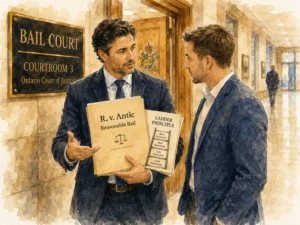
R. v. Antic

The Supreme Court of Canada clarified bail law across Canada, confirming that accused persons are entitled to the least restrictive form of release unless stricter conditions are clearly justified.

Read More »

R. v. J.M. (2017 ONCA)

The Ontario Court of Appeal reinforced that credibility findings in intimate partner cases must be carefully analyzed and grounded in proper legal principles.

Read More »

R. v. McIntosh (1995 SCC)

The Supreme Court of Canada clarified how self-defence works in criminal law, confirming that reasonable defensive force may justify an acquittal depending on the circumstances.

Read More »

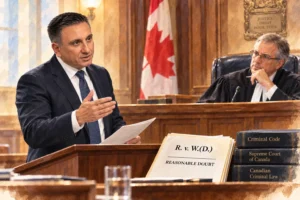
R. v. W.(D.)

The Supreme Court of Canada confirmed that when credibility conflicts arise in criminal trials, the accused must be acquitted if their evidence raises a reasonable doubt.

Read More »

R. v. G.A.P.

The Ontario Court of Appeal confirmed that domestic assault is treated as a serious offence requiring strong denunciation and deterrence in sentencing.

Read More »

R. v. Stark

The court found the accused not guilty after closely examining whether police had proper grounds to demand a breathalyzer in an impaired driving investigation.

Read More »

R. v. Stankewich

A DUI case where the court found that an initial roadside breath test “fail” was not enough to secure a conviction, closely examining the reliability of the impaired driving investigation.

Read More »

R. v. Roberts

A DUI case where the court found the BAC evidence was not strong enough to convict, closely examining Charter protections and whether the impaired driving investigation met strict legal standards.

Read More »

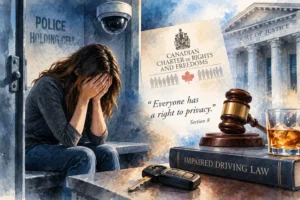
R. v. Mok

R. v. Mok examines how Charter privacy rights apply during an impaired driving investigation and whether evidence obtained during a DUI arrest can be excluded.

Read More »

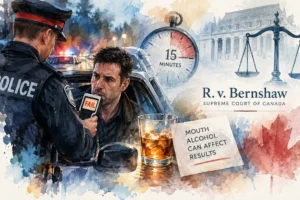
R. v. Bernshaw

When do the police have reasonable and probable grounds to demand a breathalyzer in an impaired driving investigation. The Court examined whether a “fail” on a roadside screening device is enough to justify a formal breath demand.

Read More »
Case Law for Criminal Defence in Ontario

R. vs. Andrews

Canadian Case Law Summary

In R. v. Andrews, the Alberta Court of Appeal confirmed that impaired driving requires proof that the accused’s ability to drive was impaired — not merely evidence of alcohol consumption or slight signs of intoxication.

Read More »