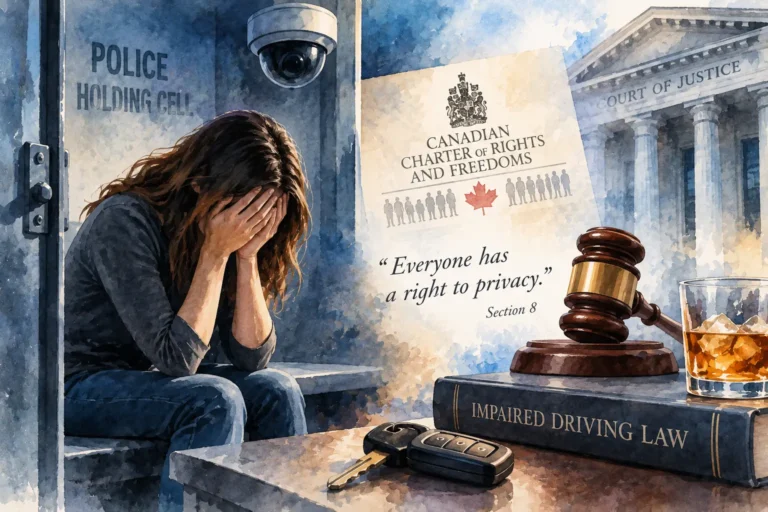
R. v. Mok – Privacy Rights & Impaired Driving
A serious breach of your privacy rights can result in charges being dropped
In R. v. Mok, the Supreme Court of Canada examined whether police violated Charter privacy rights during an impaired driving investigation.
The case focused on how breath samples were obtained from an impaired driving arrest and whether the procedures complied with constitutional standards. The Court clarified the limits of police authority during DUI arrests.
If you’ve been charged with impaired driving or another DUI offence and have questions about how the police collected the evidence against you, speak with Nicholas Charitsis. We can review the breath tests, police procedures and other evidence to determine whether your Charter rights were respected and whether any of the evidence can be challenged.
Relevant Case Law:
R. v. Mok — Supreme Court of Canada (1995 SCC 7)
[View the full decision on CanLII (Canadian Legal Information Institute)]
What Happened in R. v. Mok?
Ms Mok was driving home after drinking at a pub when a York Regional Police officer saw her travelling the wrong way on Yonge Street. She nearly hit one median, struck another, failed to stop immediately for the police, and then drove into an oncoming lane.
When she was finally stopped, the officer smelled alcohol and found her so unsteady that he had to help keep her from falling. She was arrested for impaired driving.
At the police station, Mok provided two breath samples. The readings were extremely high — 296 mg and 284 mg of alcohol in 100 mL of blood, more than three times the legal limit. Because of her condition, police kept her in custody until they believed she was sober enough to understand the conditions of her release.
What Happened at the Police Station
But what happened while Mok was in the police holding cell became the central issue in the case.
The cell was under continuous video surveillance, including the toilet. Mok used the toilet twice without realizing that she was being recorded. The camera captured her fully exposed, and the recording could be monitored by both male and female police officers.
The defence argued that this was a serious violation of Mok’s privacy rights under the Canadian Charter of Rights and Freedoms. The judge agreed.
Although people in police custody have less privacy than they normally would, the judge found that this did not mean they had no right to privacy at all when using a toilet. The practice of recording detainees using the toilet was described by the Court as demeaning and contrary to human dignity.
The judge concluded that the police had violated Mok’s section 8 Charter rights. The violation was serious enough that allowing the prosecution to continue would undermine the integrity of the justice system.
The Legal Issue in R. v. Mok
R. v. Mok required the Supreme Court of Canada to examine whether police conduct violated section 8 of the Charter.
The issue was whether the collection of bodily samples during an impaired driving investigation amounted to an unreasonable search and seizure. The Court had to determine whether the procedures used were legally authorized and constitutionally compliant.
The Court considered whether:
- The search was authorized by law
- The law itself was reasonable
- The search was carried out in a reasonable manner
- The accused’s privacy interests were unjustifiably infringed
The case focused on balancing impaired driving enforcement with fundamental privacy rights. The decision clarified how courts assess constitutional compliance during DUI arrests.
What the Court Decided in R. v. Mok
The Supreme Court reviewed whether the police investigation complied with Charter standards. The Court emphasized that bodily samples engage significant privacy interests. It confirmed that constitutional protections apply fully during impaired driving investigations.
The Court held that:
- Bodily samples constitute a search under section 8 of the Charter
- Police must have clear statutory authority before conducting the search
- The search must be carried out reasonably
- Evidence obtained through a rights breach may be excluded
The decision reinforced that impaired driving enforcement does not override your rights as a Canadian in Canada. Courts must carefully assess whether police respected privacy rights before admitting evidence.
Key Legal Principles from R. v. Mok
R. v. Mok clarified how privacy rights operate during impaired driving investigations. The Court reinforced that bodily samples are highly intrusive vs breath samples and trigger strong constitutional protections. Police authority must be grounded in clear statutory compliance.
The decision confirms that:
- Bodily samples are considered a search under section 8
- A lawful search requires proper authorization under the Criminal Code
- The manner of the search must be reasonable
- Charter breaches can result in exclusion of evidence
- Courts balance societal interests against individual privacy rights
When police exceed lawful limits, the defence may seek that evidence obtained be excluded from any criminal proceedings.
How R. v. Mok Can Affect an Impaired Driving Defence
R. v. Mok provides a framework for challenging investigative steps that intrude on privacy rights. In an impaired driving defence, the legality of how evidence was obtained can be decisive. Courts will examine whether police respected constitutional limits at every stage.
A defence may review whether:
- The search was clearly authorized by statute
- The search was carried out reasonably
- The accused’s Charter rights were properly explained
- The procedure complied with the Criminal Code
- Any breach justifies exclusion of evidence
If a Charter violation is established, key evidence may be excluded. In impaired driving prosecutions, that exclusion can significantly weaken the Crown’s case.
Waiting for your direction before proceeding to the FAQ section.
Frequently Asked Questions About R. v. Mok
R. v. Mok is often raised when privacy rights are challenged in impaired driving cases. The decision helps define when evidence obtained during a DUI arrest may be excluded. Below are common questions clients ask.
What rights were at issue in R. v. Mok?
The case focused on section 8 of the Charter, which protects against unreasonable search and seizure. The Court examined whether obtaining bodily samples during an impaired driving investigation violated privacy rights.
Does Mok mean all DUI evidence can be excluded?
No. Evidence is excluded only where a Charter breach is proven and exclusion is justified. Courts assess the seriousness of the violation and its impact on trial fairness.
How does R. v. Mok apply today?
Mok reinforces that police must comply strictly with constitutional standards during impaired driving investigations. Defence counsel may rely on it where privacy rights were infringed.