R. v. Bernshaw | Breathalyzer Demands
Canadian Case Law Summary
In R. v. Bernshaw, the Supreme Court of Canada confirmed that a “fail” result on an approved roadside screening device justifies a breathalyzer demand. The Court held that police may rely on the screening result unless there is clear evidence of unreliability. Because the officer acted reasonably, the conviction was restored.
If you have been charged with impaired driving, the legality of the breath demand can be critical. Courts rely on appellate decisions to interpret and apply the Criminal Code. For a demand for breath samples on an approved instrument, police generally need reasonable grounds to believe an impaired driving offence occurred.
If you’re facing an impaired driving charge, breathalyzer evidence is the part of your defence that you need to discuss with a DUI lawyer. Nicholas is a former Crown Attorney with 25 years of criminal law experience in Toronto and more than 350 five-star Google reviews.

If you’ve been arrested for a DUI charge, call and discuss your case directly with Nicholas Charitsis at 416-731-7113.
The Legal Issue in R. v. Bernshaw
The central issue in R. v. Bernshaw was whether a roadside screening device “fail” automatically provides reasonable and probable grounds for a breathalyzer demand. The Supreme Court had to determine whether the officer’s belief was objectively reasonable at the time the demand was made.
The Court examined whether:
- A “fail” result alone is enough to justify a breath demand
- Police must investigate possible reliability concerns before making the demand
- The officer’s belief must meet an objective legal standard
- Suspicion can be distinguished from reasonable and probable grounds
At its core, the case focused on the threshold required before police can lawfully compel breath samples. The decision clarified how courts assess grounds in impaired driving investigations and how that standard applies in practice.
Relevant Case Law:
R. v. Bernshaw — Supreme Court of Canada (1995 SCC 150)
[View the full decision on CanLII (Canadian Legal Information Institute)]
What Happened in R. v. Bernshaw?
Mr. Bernshaw’s vehicle was observed by the police travelling above the speed limit and drifting from the shoulder toward the centre of the road. After stopping the vehicle, the police officer detected the smell of alcohol, noticed that Bernshaw’s eyes were red and glassy, and learned that he had been drinking.
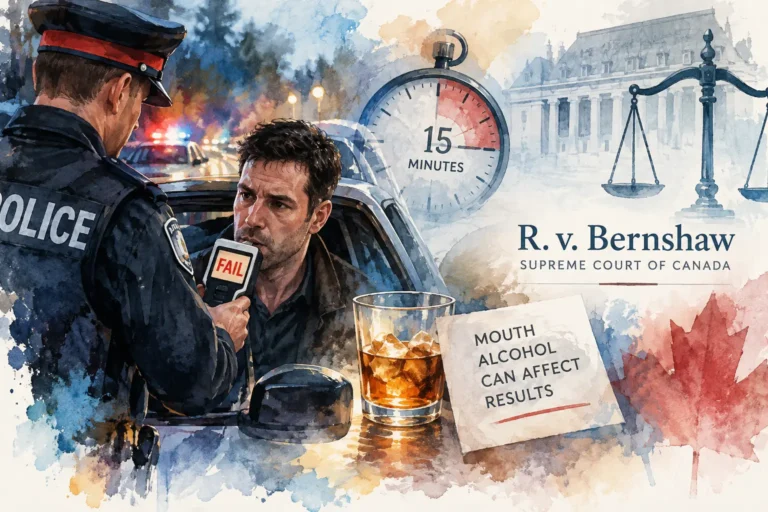
The officer demanded a roadside breath sample using an ALERT screening device. Bernshaw provided the sample and registered a “fail.”
Based on that result, the officer made a further demand for breath samples and took him to the police station. Two breath samples were obtained, both showing a blood alcohol level above the legal limit. Bernshaw was convicted at trial.
The case, however, turned on the reliability of that first roadside test.
Evidence at trial showed that alcohol remaining in the mouth after a recent drink could falsely increase the reading on a roadside screening device. Police training materials recommended waiting approximately 15 minutes where recent drinking might affect the accuracy of the test.
This raised the question of whether the officer could properly rely on the roadside “fail” as the basis for demanding the later breath samples.
The Supreme Court of Canada explained that a failed roadside test can be used along with other signs of impairment to establish grounds for a breath demand. However, a “fail” result does not automatically provide those grounds in every case. If there is credible evidence that the roadside result may have been unreliable, that must be considered when deciding whether the officer had lawful grounds to proceed.
In the end, Bernshaw was acquitted and found not guilty.
What the Court Decided in R. v. Bernshaw
The Supreme Court of Canada allowed the Crown’s appeal and restored the conviction. The Court ruled that the officer had reasonable and probable grounds to demand a breathalyzer based on the roadside “fail” result. It confirmed that police may rely on approved screening devices unless there is concrete evidence of unreliability.
The Court emphasized that:
- A roadside screening device “fail” is strong evidence supporting a breath demand
- Police do not need scientific certainty before making the demand
- Reasonable grounds are assessed objectively, not with hindsight
- Officers are not required to eliminate every theoretical source of error
The decision reinforced that impaired driving investigations must be practical and workable. Courts will examine whether the officer acted reasonably in the circumstances, not whether alternative explanations were possible.
Key Legal Principles from R. v. Bernshaw
R. v. Bernshaw clarified the legal standard required before police can demand a breath sample. The Supreme Court focused on how reasonable and probable grounds are formed during an impaired driving investigation. The decision continues to guide courts when breath demands are challenged.
The Court confirmed that:
- A roadside screening device “fail” can establish reasonable and probable grounds
- Police are entitled to rely on approved screening equipment
- The standard is objective reasonableness, not scientific certainty
- Officers are not required to eliminate every speculative source of error
- Grounds are assessed based on what the officer knew at the time
These principles remain central in modern impaired driving prosecutions. Courts examine whether the investigative steps were lawful before admitting breath evidence at trial.
Why R. v. Bernshaw Still Matters Today
Although decided in 1995, R. v. Bernshaw remains highly relevant in modern impaired driving prosecutions. The decision continues to shape how courts assess the legality of breath demands. It is frequently cited when defence counsel challenge whether police had proper grounds.
The case matters because it clarifies that:
- A screening device “fail” is significant evidence supporting a breath demand
- Courts assess the officer’s belief at the time, not with hindsight
- The legal standard is reasonable grounds, not absolute proof
- Breath evidence may be excluded if the grounds requirement is not met
In many impaired driving cases, the validity of the breath demand becomes a central issue. Bernshaw defines the framework courts use when deciding whether breath test results are admissible.
How R. v. Bernshaw Can Affect an Impaired Driving Defence
R. v. Bernshaw does not make breath demands immune from challenge. Instead, it defines the legal framework courts use to assess whether police acted lawfully. In an impaired driving defence, the focus often shifts to whether reasonable and probable grounds truly existed at the time of the demand.
A defence may examine whether:
- The screening device used was properly approved
- The officer accurately recorded signs of alcohol consumption
- There were specific indicators of device unreliability
- The breath demand complied with the Criminal Code
- The accused’s Charter rights were respected
If reasonable grounds were lacking, breath test evidence may be excluded. Understanding how courts apply Bernshaw can be critical when defending an impaired driving charge.
Frequently Asked Questions About R. v. Bernshaw
R. v. Bernshaw is often raised when breath demands are challenged in impaired driving cases. The decision helps define when police are legally entitled to require breath samples. Below are common questions that arise in court and during consultations.
What did R. v. Bernshaw decide?
The Supreme Court ruled that a roadside screening device “fail” can provide reasonable and probable grounds for a breathalyzer demand. Police may rely on the approved device unless there is evidence suggesting the result was unreliable.
Do police have to rule out mouth alcohol before demanding a breath test?
No. The Court held that officers are not required to eliminate every possible source of error unless there is specific evidence raising reliability concerns.
Can a breath demand still be challenged after Bernshaw?
Yes. A demand may still be challenged if the officer lacked objectively reasonable grounds or failed to follow proper procedure. Courts will examine whether the legal standard was met at the time of the demand.
How does this case affect impaired driving charges today?
Bernshaw remains part of the legal framework used in impaired driving prosecutions. Courts rely on it when deciding whether breath evidence should be admitted at trial.