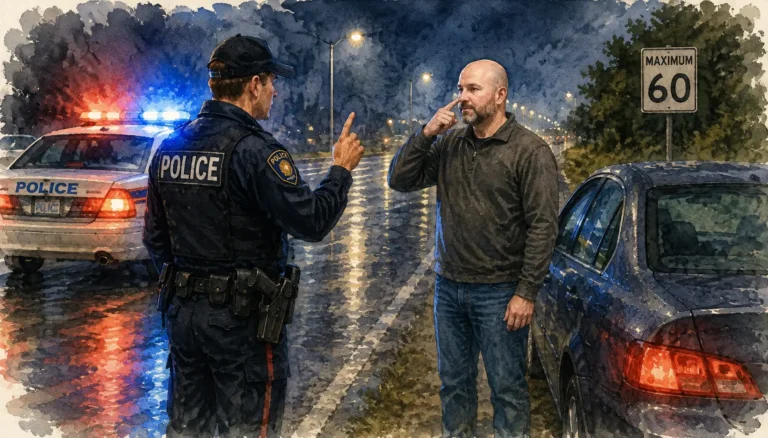
Police Evidence in Impaired Driving Cases
Police Evidence and Impairment in Canadian DUI Cases
As DUI lawyers, Charitsis Law when reviewing the police disclosure in and impaired driving case we examine the police officers notes, observations and any opinion evidence. When defending impaired driving charges, R. v. Graat is an important Supreme Court of Canada decision dealing with when a police officer can give opinion evidence impaired driving.
Led by former Crown Attorney Nicholas Charitsis, our criminal lawyers review the officer’s notes, observations, witness evidence, and Crown disclosure to identify weaknesses or inconsistencies that may help fight an impaired driving charge.
If you have been charged with a DUI offence, speak directly with former Crown Attorney Nicholas Charitsis. He will review the evidence against you, answer your questions, and explain how your DUI charge can be fought. Call 416-731-7113 today for a confidential consultation.
What Happened in R. v. Graat?
At approximately 2:15 a.m., London police officers saw Anthony Graat driving at a high rate of speed. They followed his vehicle for several blocks and observed it weaving within the lane, crossing the centre line twice, driving onto the shoulder, and straddling the centre line while making a left turn.
After stopping Mr. Graat, both officers reported smelling alcohol on his breath. They said he was unsteady on his feet, staggered when he walked, and had bloodshot eyes. At the police station, a sergeant also observed an odour of alcohol, swaying of Mr. Graat’s upper body and what he described as a “wavy” walk.
Mr. Graat complained of chest pains and told police that he had a heart condition. At his request, police took him to the hospital. By the time he returned to the police station, it was too late to obtain the required breath samples within the applicable time period.
Mr. Graat testified that he had consumed two drinks of gin earlier in the day and two glasses of wine with dinner. He had been returning from a sailing party with two friends and said he became tired. One of his friends drove for part of the trip while Mr. Graat slept in the back seat. Mr. Graat later resumed driving after his friends had been dropped off.
With no breath-test evidence available, the impaired driving case depended heavily on the officers’ observations and testimony. At trial, the police officers were permitted to give their opinions that Mr. Graat’s ability to drive was impaired by alcohol.
Mr. Graat was convicted of impaired driving. His appeals through the lower courts were unsuccessful, and the case eventually reached the Supreme Court of Canada, where an important issue was whether police officers could give this type of opinion evidence about a driver’s impairment.
Relevant Case Law:
R. v. Graat — Supreme Court of Canada (1982 SCC)
[View the full decision on CanLII (Canadian Legal Information Institute)]
How This Helps an Impaired Driving Defence
Although Mr. Graat was convicted, the Supreme Court placed important limits on police opinion evidence in an impaired driving case. An officer may give an opinion that a driver appeared impaired based on personal observations, but that opinion does not automatically prove the charge.
The judge must consider the officer’s opinion together with all of the other evidence and can accept all, part, or none of it. Importantly, a police officer’s opinion should not be given greater weight simply because the officer has experience dealing with impaired drivers.
For the defence, this means the observations supporting the officer’s opinion can be challenged. The defence can examine what the officer actually saw, whether there are other explanations for those observations, and whether the evidence as a whole proves impairment beyond a reasonable doubt.
Can Police Give Opinion Evidence About Impairment?
How police observations can be used as evidence in an impaired driving case.
As impaired driving lawyers and especially in many DUI Charges, we consider what the courts said in R. v. Graat when reviewing how police testimony is used in impaired driving cases. The Supreme Court confirmed that an officer can give opinion evidence based on what they personally observed.
The Court confirmed that:
- Police can give opinion evidence about impairment: They do not need to be qualified as experts.
- The opinion must be based on observations: Smell, speech, balance, and behaviour matter.
- The court must assess reliability: The opinion is not automatically accepted.
- The burden of proof remains on the Crown: The opinion must support proof beyond a reasonable doubt.
This ruling allows officer testimony, but it does not guarantee conviction.
Can a Police Officer Say You Were Impaired?
The Supreme Court had to decide whether a police officer could give opinion evidence about intoxication without being formally qualified as an expert. The issue was whether this type of evidence was allowed under normal rules of evidence, or do they have to be declared as an expert witness?
The Court examined:
- Can an ordinary witnesses can give opinion evidence: Some opinions are allowed.
- Are the police observations are helpful to the court: Courts rely on practical experience.
- Whether expert qualification was required: Not all opinions require experts.
- Is fairness to the accused preserved: The burden of proof must remain high.
The focus was on practical courtroom evidence.
What the Court Confirmed
The Court confirmed that opinion evidence from police officers is allowed in certain situations in impaired driving cases. However, it must be based on clear observations.
The Court confirmed that:
- Officers can testify about what they saw and smelled: Observations must be specific.
- They can give an opinion on driver impairment: Experience can support that opinion.
- The judge decides how much weight to give the opinion: It is not automatic proof.
- The Crown must still prove guilt beyond a reasonable doubt: Opinion alone is not enough.
This protects fairness while allowing practical evidence.
Police Observations Used as Evidence of Impairment
In impaired driving cases, the Crown often relies on officer testimony. R. v. Graat explains how that testimony is used.
Important defence points include:
- Officer opinions can be challenged: Cross-examination matters.
- Observations must be clear and detailed: Vague statements weaken the case.
- Alternative explanations may exist: Fatigue, stress, or medical issues can affect behaviour.
- Opinion evidence is not automatic proof: Courts must assess credibility.
- Reasonable doubt must result in acquittal: The burden never shifts.
This case shapes how impairment evidence is tested in court.
Challenging Police Evidence in Impaired Driving Charges
This decision allows defence lawyers to challenge the strength of police observations. Not every opinion equals proof.
A defence strategy may include:
- Examining the officer’s training and experience: Experience affects reliability.
- Reviewing the exact observations recorded: Details matter.
- Identifying inconsistencies: Small differences can create doubt.
- Presenting alternative explanations for behaviour: Context is important.
- Reinforcing the high burden of proof: Criminal standards remain strict.
Police opinion must stand up to scrutiny.
How Impaired Driving Lawyers Challenge Police Evidence
If you are facing an impaired driving charge in Ontario, the officer’s opinion may play a central role in your case. That opinion must be based on clear observations and must support proof beyond a reasonable doubt.
Call 416-731-7113 now to speak directly with a criminal defence lawyer and get immediate guidance about your situation.
Impaired driving Lawyers for DUI Defence
If you are facing a DUI or any drinking and driving charge, Charitsis Law represents clients throughout Southern Ontario. Meet with an experienced criminal defence lawyer at our offices in Brampton, Oshawa, Aurora, Newmarket, or Muskoka, or contact us to discuss your case and the court process.
Speak With Nicholas Charitsis Today
You’ll speak directly with Nicholas Charitsis—not a call centre or an intake representative.

When you call Charitsis Law, you’ll speak directly with Nicholas Charitsis. He’ll answer your questions, explain your legal options, and help you understand the evidence against you.
Call 416-731-7113 today to arrange your confidential case review.
Frequently Asked Questions About R. v. Graat
Q. What did R. v. Graat decide?
A. The Supreme Court confirmed that police officers can give opinion evidence about impairment based on what they observe. They do not need to be qualified as expert witnesses. However, their opinion must be based on clear and specific observations. The court decides how much weight to give that evidence.
Q. Can a police officer say I was impaired without being an expert?
A. Yes. Under R. v. Graat, an officer can give an opinion based on their experience and what they observed. However, that opinion must be supported by facts. The defence can challenge the accuracy of those observations. The Crown must still prove impairment beyond a reasonable doubt.
Q. How does this case affect my charge?
A. If you are charged with impaired driving in Ontario, the officer’s opinion may be used as evidence against you. This case allows that opinion to be presented in court. However, it does not guarantee conviction. Your lawyer can challenge the strength, detail, and reliability of those observations to create reasonable doubt.
Q. Is police opinion enough to convict me?
A. Not automatically. Courts must look at the full evidence, not just opinion. The judge must decide whether the opinion is reliable and supported by facts. If the evidence leaves reasonable doubt, there should be no conviction. The burden always remains on the Crown.
Q. Why should I speak to a criminal defence lawyer quickly?
A. Impaired driving charges carry serious penalties in Ontario, including licence suspension and a criminal record. Early legal advice allows your lawyer to review the officer’s notes and observations. Small details can change how opinion evidence is viewed. Immediate guidance helps protect your rights and future.