R. v. Andrews | Signs of Impairment in DUIs
Canadian Case Law Summary
In R. v. Andrews, the Alberta Court of Appeal confirmed that slight signs of intoxication are not enough. Judges must focus on whether the accused’s ability to drive was impaired. Because the trial judge failed to apply that distinction, the conviction was overturned.
As lawyers for impaired driving charges we want you to know that: the Crown must prove more than the presence of alcohol in your system.
In Canadian criminal law, courts rely on prior court decisions to interpret and apply the Criminal Code. A conviction for impaired driving requires proof beyond a reasonable doubt that your ability to operate a motor vehicle was impaired by alcohol or a drug.
Where you’ve been charged with impaired driving, call and speak to Toronto DUI lawyer Nicholas Charitsis at 416-731-7113.
Relevant Case Law:
R. v. Andrews — Alberta Court of Appeal (1996 ABCA 23)
[View the full decision on CanLII (Canadian Legal Information Institute)]
The Legal Issue in R. v. Andrews
The Alberta Court of Appeal had to decide whether the correct legal test was applied at trial. Impaired driving cases often turn on subtle distinctions. This case clarified exactly what the Crown must prove in court.
- The issue was not simply whether the accused had consumed alcohol.
- The issue was not whether he showed slight signs of intoxication.
- The law does not criminalize mere alcohol consumption.
- The real question was whether his ability to drive was impaired.
- The impairment must relate directly to operating a motor vehicle.
- Slight deviation from normal behaviour is not automatically proof.
- Judges must focus on functional driving capacity.
The trial judge focused on general “slight impairment.” The Court of Appeal held that this was not enough. The legal test requires proof that alcohol impaired the ability to drive.
This distinction protects against convictions based on minor or ambiguous signs. It ensures that the burden remains on the Crown to prove actual driving impairment beyond a reasonable doubt.
Driver Acquitted – Breathalyzer Evidence Challenged
Mr. Andrews was stopped after police observed him travelling about 80 km/h in a 50 km/h zone, making an abrupt lane change and turning without signalling.
The officer smelled alcohol and observed bloodshot eyes, slightly slurred speech and some difficulty with balance. Andrews failed a roadside screening test, and a later breathalyzer test showed 100 mg of alcohol per 100 mL of blood. He was charged with both impaired driving and driving over 80.
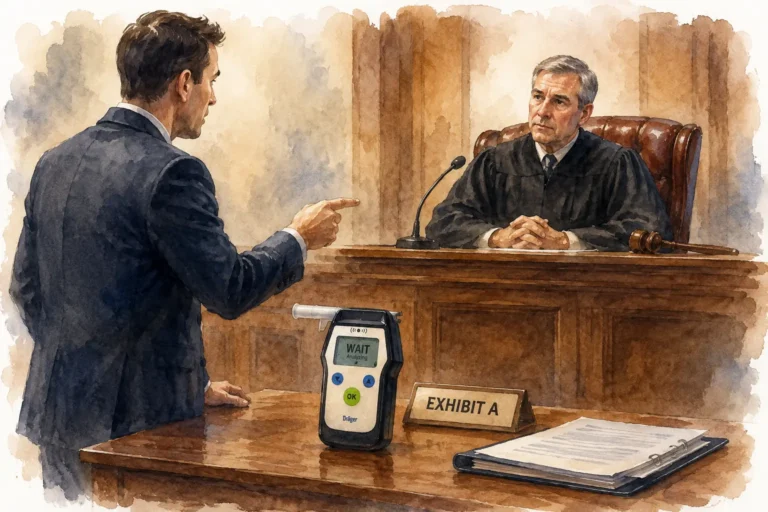
At trial, the defence lawyer challenged the breathalyzer evidence with expert testimony about how his body absorbed and eliminated alcohol. The judge found that this evidence raised a reasonable doubt about the 100 mg reading and accepted that his actual blood alcohol level could have been below 80 mg. As a result, Andrews was found not guilty of the Drive Over 80 charge.
The impaired driving charge was different because the Crown could still rely on the officer’s observations of Andrews’ driving and physical condition.
The case illustrates an important distinction in drinking and driving cases: successfully challenging a breathalyzer reading does not automatically defeat an impaired driving charge. The Crown may still try to prove impairment using evidence about the accused’s driving, speech, balance, appearance and behaviour.
What the Court Decided
The Court of Appeal carefully reviewed how the trial judge applied the law. The focus was not on whether alcohol was consumed. The focus was whether the correct legal standard was used.
- The court confirmed that impairment must relate to the ability to drive.
- Any degree of impairment can be sufficient — but only if it affects driving capacity.
- The trial judge treated general impairment as enough for conviction.
- The judge did not clearly analyze whether driving ability was impaired.
- The distinction between “impairment” and “impairment of the ability to drive” is crucial.
The Court of Appeal found that the wrong legal test had been applied. Because of that error, the conviction was quashed and a new trial was ordered.
This decision reinforces that courts must apply the correct legal standard. A conviction cannot stand unless the evidence proves impairment of the ability to operate a motor vehicle beyond a reasonable doubt.
Key Legal Principles From R. v. Andrews
This decision clarified how impaired driving cases must be analyzed. The court identified important principles that continue to guide prosecutions across Canada.
- The Crown must prove impairment of the ability to drive.
- Alcohol consumption alone does not establish the offence.
- Slight impairment is not enough unless it affects driving capacity.
- Deviation from normal behaviour is a tool of proof, not the legal test itself.
- The standard of proof remains beyond a reasonable doubt.
- Judges must connect the evidence directly to functional driving ability.
These principles protect against convictions based on assumptions. They require courts to focus on real impairment, not minor or ambiguous signs.
R. v. Andrews confirms that the offence is about impaired driving ability — not simply drinking and driving.
Why R. v. Andrews Matters for Drinking & Driving Cases
Although this case was decided in 1996, its reasoning remains highly relevant. Modern impaired driving prosecutions still require courts to apply the same core principles.
- Police observations must relate to driving ability, not just appearance.
- Physical signs like red eyes or odour of alcohol are not automatic proof.
- Minor driving errors do not always establish impairment.
- Expert evidence may challenge assumptions about alcohol levels.
- Courts must analyze the totality of the evidence carefully.
This decision continues to shape how judges evaluate impaired driving cases. It reinforces that the law targets impaired driving ability, not mere alcohol consumption.
For anyone facing an impaired driving charge, the distinction clarified in R. v. Andrews can be legally significant.
How R. v. Andrews Can Affect an Impaired Driving Defence
This case is not just academic. It can directly influence how an impaired driving charge is defended in court. The legal test clarified in R. v. Andrews shapes how evidence must be analyzed.
- The defence can argue that signs of alcohol use do not automatically prove impaired driving.
- The focus must remain on actual driving ability, not general behaviour.
- Minor symptoms may be consistent with explanations other than impairment.
- The Crown must connect observations directly to reduced driving capacity.
- Any doubt about impairment of the ability to drive must result in acquittal.
In many cases, the issue is not whether alcohol was consumed. The issue is whether the evidence proves that the ability to operate a motor vehicle was impaired beyond a reasonable doubt. That distinction can be decisive in court.
Frequently Asked Questions About R. v. Andrews
What did the court clarify in R. v. Andrews?
The court clarified that impaired driving requires proof that the accused’s ability to drive was impaired. General signs of alcohol consumption are not enough. The focus must remain on functional driving capacity.
Is slight impairment enough for a conviction?
Slight impairment can be sufficient, but only if it affects the ability to operate a motor vehicle. The Crown must prove that driving ability was impaired beyond a reasonable doubt.
Does alcohol consumption automatically mean guilt?
No. Drinking alcohol does not automatically result in a conviction. The law does not criminalize consumption alone. The key issue is whether the ability to drive was impaired.
Why was the conviction overturned in R. v. Andrews?
The Court of Appeal found that the trial judge applied the wrong legal test. The judge focused on general impairment instead of determining whether the accused’s ability to drive was impaired.
Why is this case still important today?
R. v. Andrews continues to guide how courts analyze impaired driving cases. It reinforces that the offence targets impaired driving ability, not simply the presence of alcohol.