
Toronto DUI Lawyer | Impaired Driving Defence
As Toronto DUI lawyers, we want you to know there are defences to impaired driving—and these charges can be won, and Charitsis Law knows how to fight them.
The criminal defence lawyers of Charitsis Law focus on fighting drinking and driving charges, including impaired driving, driving over 80 mg and refuse breath test charges.
Former Toronto Crown Attorney Nicholas Charitsis and our DUI lawyers bring:
- 25+ years of experience fighting impaired driving charges
- Hundreds of successful DUI cases
- 350+ five-star Google reviews, with hundreds of other reviews across the internet.
- Experience challenging breathalyzer evidence and police procedures
Our DUI lawyers represent people charged with impaired driving and all drinking and driving charges throughout Toronto and the GTA.
A DUI charge does not mean you will be found guilty. Breath testing, police procedures, disclosure, witness evidence and Charter of Rights issues can all affect the case. Our DUI lawyers review what happened from the initial traffic stop through to the breathalyzer tests building strong defences to impaired driving.

If you’ve been arrested for a DUI Charge, discuss your case directly with Nicholas Charitsis at 416-731-7113.
What Are the Defences to Impaired Driving?
There more defences for impaired driving charge than many people realize.
Our Toronto DUI lawyers review breathalyzer evidence, look for police mistakes and check whether your rights were violated. At trial, we use cross-examination to question police officers and challenge their evidence.
Problems With Breathalyzer Testing
Impaired driving laws in Canada are strict, both for drivers and for the Police.
Police officers must follow specific rules when making arrests and collecting breath samples. During an impaired driving trial and pre-trial discussions with the crown attorney we’re going to carefully review:
- Timing and delays: We check when the breath demand was made, when samples were taken, the time between tests and any unexplained delays.
- Police procedures and equipment use: We review whether the arrest and breath demand was lawful. Did the qualified breathalyzer technician operate the approved instrument properly.
- Breathalyzer records and accuracy: We examine test results, breathalyzer certificates, calibration checks and testing records for inconsistencies or missing information.
Driving over the legal limit of over .80 mgs, does not necessarily end the case. Breathalyzer tests must be done properly, following the law, without errors or inconsistencies.
Breathalyzer Evidence Helped Win this DUI Case
Nicholas Charitsis challenged the breathalyzer’s reliability, and our client’s refusal charge was dismissed. Read how breathalyzer evidence helped win this DUI case →
DUI Defence: Challenging Police Evidence
Police officers investigating drinking and driving charges must the rules and proper procedures when making arrests for impaired driving. In cross-examining the police we’re looking for:
This can include reviewing:
- Traffic stop, arrest and breath demand: We check whether police had legal authority to stop you, arrest you and demand breath samples.
- Police evidence and disclosure: We compare reported signs of impairment with video, police notes and witness statements. We also check the evidence provided by the Crown Attorney for missing records or information.
- Your right to a lawyer: We check whether police explained your rights and gave you a proper chance to speak privately with a lawyer.
Police evidence should not simply be accepted as correct. Video, records and other evidence can sometimes tell a very different story.
The Police Video Helps Win Impaired Driving Case
Police video contradicted the officer’s claims, and the driver was found not guilty of impaired driving and over 80.. Read how police evidence was challenged in R. v. Palacios →
Charter Rights & Legal Defences to DUI Charges
Charter rights violations, missing evidence and unreasonable court delays can give us grounds to challenge the evidence in a charge of impaired driving. Legal arguments include issues such as:
- Charter rights and access to a lawyer: We check whether police respected your Charter rights, including your right to speak privately with a lawyer.
- Unreasonable trial delays: We review how long your case has taken and what caused the delays. We look for grounds to ask the court to end the case.
- Missing disclosure and challenges to evidence: We check whether the Crown Attorney has provided the records needed to prepare your defence. We also look for legal grounds to keep breath test results or other evidence out of court.
When your Charter of Rights have been violated, the appropriate remedy is for the judge to dismiss the charge.
DUI Case Ended After an 11(b) Charter Application
Nicholas Charitsis challenged delays caused by missing breathalyzer records, and the court stayed the DUI charges. Read how an 11(b) Charter application ended this DUI case →
Care and Control Defence: No Intention to Drive
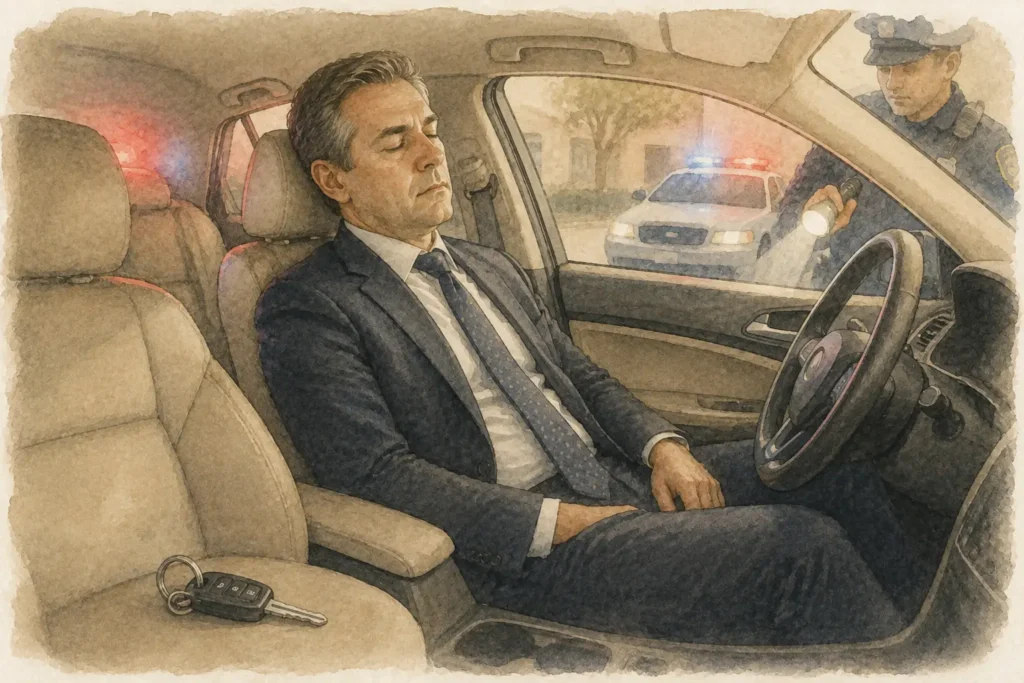
You can be charged with impaired driving even when the vehicle is not moving. However, being impaired and sitting in the driver’s seat does not always mean you intended to drive. Our defence strategy for care and control while impaired includes:
- You had a plan to get home: Was there a plan other than driving? Text messages, phone records and witness statements can show that someone was coming to pick you up, and you had no intent do drive.
- The vehicle and keys: Where were the keys? Was the engine was running and where was the vehicle was parked?
- Your actions and intentions: We look at where were you in the vehicle when the police arrived, drivers seat or passenger seats? Why you entered the driver’s seat and what may of happened before the police arrived.
The main issue in care and control charges is, what was the drivers intent, where was the driver, and what statements may have been made to the police?
Text Message Helps Win Care and Control Case
A text showed our client had arranged a ride home, supporting his defence of no intent to drive and a not-guilty verdict. Read how evidence of no intention to drive helped win this DUI case →
More Defences to Impaired Driving Charges
Explore our guide to 25 defences to impaired driving charges for more ways to challenge the evidence and fight your DUI charge.
★★★★★ “By far the best DUI Lawyer in Toronto. Nicholas and his team are hard working specialists in the field of criminal law. Nick is always available to answer questions and guides you through the process. All charges dropped! Thank you.”
DUI Penalties for Impaired Driving
How the Penalties for Drinking and Driving Affect You.
In Ontario, any conviction for an impaired driving or DUI charge include fines, a driving prohibition, licence suspension, ignition interlock requirements, a criminal record, and, in some cases, jail.
A conviction leads to higher insurance costs and may affect employment, travel, and an immigration status.
- Fines and jail: First offences generally carry minimum fines. Repeat offences carry minimum jail sentences, and serious cases can bring longer sentences. Read about impaired driving penalties.
- Driving bans, licence suspension and ignition interlock: A drinking and driving conviction generally brings a court-ordered criminal driving prohibition and an Ontario licence suspension. Returning to driving also involves ignition interlock requirements.
- Criminal record, employment and travel: A criminal record can affect job opportunities, professional licensing and travel, depending on the destination. Permanent residents and foreign nationals can also face serious immigration consequences.
Read our guide to DUI penalties in Ontario for details on fines, jail sentences, licence suspensions and how a DUI charge affects immigration and citizenship.
What Is Impaired Driving – Explaining DUI Law
Understanding impaired driving charges, DUI offences, & Canada’s impaired driving laws.
Depending on what happened and the evidence gathered by police, you may be charged with one or more of the following offences:
- Impaired Operation – Police allege your ability to operate a motor vehicle was impaired or changed because of the consumption of alcohol or drugs.
- Driving Over 80 – When the driver gave a breath sample, the blood/alcohol concentration (BAC) was over the legal limit of .08. This is a separate offence from impaired operation and is based primarily on the breath test evidence. Read more about Driving Over 80 charges.
- Refuse Roadside Breath Test – The driver refused to provide a breath sample into an Approved Screening Device after a lawful roadside demand by a police officer. A refusal does not always mean the driver simply said no. Read more about refusing a roadside breath test.
- Refusing a Breathalyzer Test – The accused refused or failed to comply with a lawful breath demand made by a police officer for a breath sample. Read more about refusing a breath sample charges.
- Care and Control while Impaired – The allegation is the driver had the “care or control” of a motor vehicle while they were impaired, even if it was parked or not moving. Read more about care and control charges.
Impaired driving is a criminal offence under the Criminal Code of Canada. The terms DUI, Driving under the influence and drinking and driving are commonly used to describe impaired driving charges involving alcohol or drugs.
★★★★★ “Nicholas and his team were very professional and helpful. I had an impairment over 0.80 charge, and Nicholas was able drop the charges down to careless driving. The case was resolved very fast, and I didn’t have to testify in court. Nicholas and his team were even able to get me, my driving privileges back right after the last court date. I am very happy with the service and would definitely recommend.”
Why Two Impaired Driving Charges?
Explaining Impaired Drivng vs Driving over .08 mgs and why 2 criminal charges for one offence.
It is common for a driver to face more than one criminal charge after an impaired driving arrest. You may be charged with just impaired driving, impaired driving & drive over 80 or impaired driving & refusing a breath test.
Impaired Driving
- An impaired driving charge focuses on whether alcohol or drugs affected your ability to drive.
- The Crown may rely on evidence such as your driving, speech, balance, coordination, behaviour, and the observations made by police officers or witnesses.
- For example: An officer may say you were weaving, had slurred speech, or appeared unsteady when you got out of the vehicle. An impaired driving lawyer can compare these observations with police notes, video, witness evidence, and your explanation of what happened.
Driving Over 80 mgs
- A charge of driving over 80 mgs, focuses on your blood alcohol concentration (BAC). Was the driver over the legal limit?
- After an arrest, police may demand breath samples on a breathalyzer at the police station. If the breath tests show a blood alcohol concentration at or above the legal level, an Over 80 charge may be laid along with the impaired driving charge. They are 2 separate offences.
- For example: You could appear to be driving normally but still be charged with Over 80 because of the breath test results are over the legal limit. The breath-testing evidence and the procedures followed by police can become important parts of the defence.
The police allege you committed two different criminal offences, driving while your ability to do so was impaired and a second criminal offence of being over the legal limit of .08mgs.
Refusing a Breath Test
- A refusal charge may be laid when a driver fails or refuses to provide a breath sample after a lawful police demand. This charge involves where the officer arrests the accused for impaired driving, they make a demand for breath test and the driver fail to provide the breath samples.
- A person may therefore be charged with impaired driving and refusal, even though police never obtained a breath reading. Again these would be 2 separate charges laid against the driver.
- For example: A driver may have tried several times to provide a sample but was unable or refuses to do so. The defence may examine the instructions given by police, the opportunities provided to give a sample, whether the demand was lawful, and whether there was a reasonable excuse.
More than one charge does not mean the Crown has proven either charge. Each offence must be proven. Our impaired driving lawyers examine the evidence behind each charge and look for weaknesses, inconsistencies, police errors, and legal issues that can create reasonable doubt.
What Does the Crown Have to Prove in Impaired Driving?
The driver’s driving ability was impaired by the consumption of an alcohol or drug.
Sounds straight forward, but many times this is an issue: The evidence must prove that, “The driver’s ability to operate a motor vehicle was impaired due to the consumption of an alcohol or drug, beyond any reasonable doubt”.
What Is Reasonable Doubt in Impaired Driving?
Reasonable doubt can be the difference between being found guilty and winning.
In Canadian criminal law, reasonable grounds means having a set of concrete, objective facts that would lead an ordinarily cautious person to honestly believe a crime was committed or evidence will be found.
When a drinking and driving charge goes to trial, the judge must consider all the evidence. If after hearing all the evidence if the judge has any doubt about whether the Crown has proven the charge, the accused must be found not guilty.
As Toronto DUI lawyers, we go through the police officers investigation and evidence. Mistakes, inconsistencies, missing evidence, unreliable police observations, or problems with breath testing and police procedures can all create reasonable doubts in an impaired driving trial.
★★★★★ “Thank you to Vadim and Charitsis Law for all their help. My DUI charge was dropped to a careless driving ticket. It was my first experience being involved with the law, and Vadim was very informative and helpful throughout the entire process. He explained everything clearly, kept me updated, and made a very stressful situation much easier. I highly recommend Charitsis Law.”
How Our DUI Lawyers Build Your Defence
Building an impaired driving defence starts with understanding what happened and comparing your account with the Crown’s evidence.
Our DUI lawyers review the disclosure, including police notes, video, breath-testing records, witness evidence and other documents. We look for inconsistencies, missing evidence, police mistakes and legal issues that could affect the Crown’s case.
The defence process can include:
- Reviewing the evidence — We compare the Crown’s disclosure with your version of events and look for problems in the evidence.
- Identifying your defences — We determine which factual, legal and Charter issues can be used to challenge the charge.
- Meeting with the Crown Attorney — At a Crown pre-trial, your lawyer can raise weaknesses in the case, discuss missing disclosure and explore possible resolutions.
- Preparing for trial — If the case proceeds to trial, we prepare to challenge the Crown’s evidence, cross-examine witnesses and present the defence.
Every DUI case is different. Your defence strategy should be based on the evidence, the law and what actually happened in your case.
Our DUI lawyers look for weaknesses in the Crown’s evidence and determine how they can be used in your defence. If the Crown cannot prove the impaired driving charge beyond a reasonable doubt, you must be found not guilty.
Recent Impaired Driving Successes
These DUI/DWI results show how legal issues can change the outcome of a DUI charge.
These real court decisions show how in impaired driving law, legal issues, careful preparation, and strong defence strategies have helped our clients successfully fight impaired driving charges.





These are just a few examples of how legal issues have helped our clients successfully fight impaired driving charges. Every case is different, and the outcome depends on the evidence, the legal issues involved, and the defence strategy. View More DUI Cases We’ve Won →
Charged With Impaired Driving – Why Choose Charitsis Law
Experience and results matter when choosing a DUI lawyer.
When you are facing an impaired driving charge, you want a lawyer with experience fighting these cases and a record you can look at. Here are some of the reasons clients choose Charitsis Law:
- 25+ Years of Impaired Driving Defence Experience — Decades of experience fighting impaired driving and DUI charges in Ontario courts.
- Former Crown Attorney — Nicholas Charitsis understands how Crown Attorneys review evidence and prosecute criminal charges.
- Proven Impaired Driving Results — Our case results show how evidence and defence strategies can be used to successfully fight impaired driving charges.
- Professional Leadership in Ontario’s Justice System — Nicholas Charitsis has held senior leadership roles with Ontario’s judicial and Justice of the Peace appointments advisory committees.
- Hundreds of Client Reviews — Former clients have shared hundreds of positive reviews about Charitsis Law, our lawyers, and the results we have achieved.
Your choice of lawyer can make a difference in how your impaired driving charge is fought. If you are looking for the best criminal lawyer in Toronto for your defence, consider Charitsis Law. Call 416-731-7113 and let’s talk about how we can fight your charge.
Speak With Nicholas Charitsis Today
You’ll speak directly with Nicholas Charitsis—not a call centre or an intake representative.

When you call Charitsis Law, you’ll speak directly with a trusted DUI lawyer in Toronto. Nicholas Charitsis can answer your questions, explain your legal options, and help you understand the evidence against you.
Call 416-731-7113 today to arrange your confidential case review.
Questions About Hiring a DUI Lawyer
These are some of the most common questions people ask before hiring an impaired driving lawyer in Ontario.
Q. How Do I Choose the Right DUI Lawyer?
A. Choosing a DUI lawyer is one of the most important decisions you’ll make after being charged. Look for a lawyer who regularly defends impaired driving cases, has extensive criminal defence experience, and can clearly explain the evidence and your legal options.
Ask whether you’ll speak directly with the lawyer handling your case, whether they have trial experience, and how they develop a defence strategy. A good lawyer should answer your questions honestly and explain both the strengths and weaknesses of your case.
Don’t choose a lawyer based on price alone. Experience, preparation, and judgment can make a significant difference in how your case is handled.
If you’re comparing lawyers, we recommend reading our guide on how to choose the right DUI lawyer before making your decision.
Q. How Much Does It Cost to Hire a DUI Lawyer?
A. The cost of hiring a DUI lawyer depends on the facts of your case. Some impaired driving charges are straightforward, while others involve Charter arguments, expert evidence, or a trial. Those factors can affect the legal fees.
Ask whether the lawyer charges a fixed fee or bills by the hour. You should also ask what services are included and whether the quoted fee covers a trial if one becomes necessary.
Choosing a lawyer based on price alone can be a costly mistake. Experience, preparation, and the right defence strategy often have a greater impact on your case than finding the lowest fee.
If you’d like to learn more, read our guide on DUI lawyer fees and legal costs before making your decision.
Q. Why Was I Charged With Both Impaired Driving and Over 80?
It’s common for police to lay more than one impaired driving charge after the same incident. For example, you may be charged with both impaired driving and having a blood alcohol concentration over the legal limit. While the charges arise from the same event, each requires the Crown Attorney to prove different legal elements.
Being charged with two offences does not mean you’ll receive two convictions. In many cases, only one conviction can be entered if both charges relate to the same incident.
An experienced DUI lawyer will review the evidence supporting each charge, identify any legal issues, and determine whether one or both charges can be challenged.
Q. What’s the Difference Between Impaired Driving and Care and Control?
Many people think you can only be charged if the police see you driving. That’s not always true.
An impaired driving charge usually involves allegations that you were operating a motor vehicle while impaired. A care and control charge applies when the police believe you had the ability to operate the vehicle, even if it wasn’t moving.
For example, a person sleeping in the driver’s seat with the keys nearby may be investigated for care and control. Whether the Crown Attorney can prove the charge depends on the evidence and the specific circumstances of the case.
To learn more, read our guide on Impaired Driving Care and Control Charges.
Q. Can Any DUI Lawyer Guarantee They’ll Win My Case?
No. An honest DUI lawyer will never guarantee that your charges will be withdrawn or that you’ll be found not guilty. Every impaired driving case is different, and the outcome depends on the evidence, the legal issues, and the facts of your case.
A good DUI lawyer will carefully review the Crown’s evidence, explain the strengths and weaknesses of your case, and recommend the defence strategy that gives you the best opportunity for success. Then they can give you their opinion as to whether they can win the case.
Be cautious of any lawyer who promises a specific outcome before reviewing the evidence. Experience matters, but so does honesty. You deserve straightforward legal advice based on the facts of your case.
About Impaired Driving Lawyer Nicholas Charitsis
Nicholas Charitsis is a Toronto criminal defence lawyer and former Crown Attorney with more than 25 years of experience defending impaired driving charges in Ontario. His practice focuses on impaired driving, Drive Over 80, breathalyzer refusals, care and control, and other DUI-related driving charges.
His experience in DUI investigations allows him to identify legal issues involving breath testing, police procedures, Charter rights, disclosure, and whether the Crown Attorney can prove an impaired driving charge beyond a reasonable doubt. He has successfully defended impaired driving cases involving reasonable doubt, breathalyzer evidence, medical issues, identity, and whether the accused intended to drive.
Nicholas also serves as Chair of Ontario committees involved in recommending candidates for judicial and Justice of the Peace appointments. His combination of courtroom experience, former Crown experience, and more than 25 years practising criminal law provides clients with experienced advice when deciding how to fight an impaired driving charge.