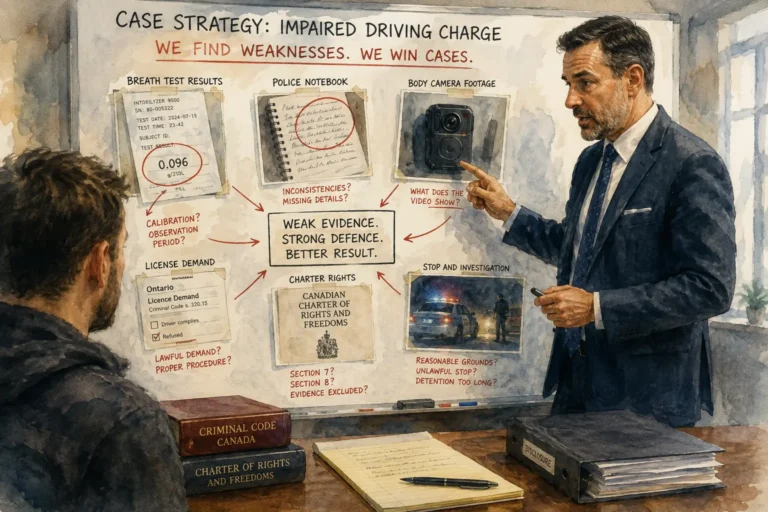
Defences to Impaired Driving Charges
Fighting an impaired driving charge starts with understanding the possible defences and carefully examining the evidence. As DUI lawyers, Charitsis Law has been defending impaired driving and drinking and driving charges for more than 25 years.
Where you need to speak to a lawyer call and speak to DUI lawyer Nicholas Charitsis, a former Crown attorney with 25 years experience defending DUI cases. Call 416-731-7113
During your case review, we look for errors, legal and evidentiary issues that may weaken the prosecution’s case. Some issues involve Charter rights, while others relate to the traffic stop, the arrest, the breath testing procedure, the reliability of the evidence, or whether the essential elements of the offence can be proven. Every case is different, and not every defence applies in every situation.
The Reason for the Traffic Stop
When we’re considering fight an impaired driving charge, every case begins with a traffic stop. Sometimes the police stop a vehicle after observing an alleged traffic offence. In other cases, the stop occurs at a RIDE program or another lawful roadside stop.
One of the first questions we examine is exactly how and why the investigation began. What did the officer observe before activating the emergency lights? What happened immediately after the stop? Did the officer’s observations remain consistent throughout the investigation?
Important Questions in DUI Defence
- Why was your vehicle stopped?
- Did the officer observe a traffic offence before stopping your vehicle?
- Was the stop part of a RIDE program?
- When did the officer first suspect impaired driving?
- Do the officer’s notes match the video evidence?
- Are the officer’s observations consistent throughout the investigation?
- Do different officers describe the traffic stop differently?
The traffic stop is often the starting point of the Crown’s case. If the evidence surrounding the stop is incomplete, inconsistent, or unsupported by the other evidence, those issues may become important when deciding whether the charge has been proven beyond a reasonable doubt.
Police Didn’t Have Enough Evidence to Make an Arrest
Before arresting someone for impaired driving, the police must have enough evidence to justify that decision. Sometimes the officer’s observations are later challenged in court.
Examples include:
- The odour of alcohol was the only observation.
- Red eyes may have been caused by fatigue or allergies.
- Slurred speech may have another explanation.
- The driver’s balance and coordination appeared normal.
- The officer misunderstood what the driver admitted to drinking.
- Video evidence does not match the officer’s notes.
Winning case example of how this impaired driving arrest played out in court >>>
Why This Matters: Small details like these can become important at trial. When the evidence is carefully examined, what first appeared to justify an arrest may not be as clear as it seemed.
Your Charter Rights Were Violated
Police officers must respect your rights under the Canadian Charter of Rights and Freedoms throughout any impaired driving investigation. If they fail to follow the Charter, it may affect whether some of the evidence can be used against you in court. Every situation is different, and even a seemingly minor mistake can become an important legal issue.
Examples That May Become Important
- You were not told why you were being detained or arrested.
- You were not informed of your right to speak with a lawyer.
- You asked to speak with a lawyer but were not given a reasonable opportunity to do so.
- Police continued questioning you after you requested legal advice.
- Officers delayed access to a lawyer without a lawful reason.
- Police obtained evidence after violating your Charter rights.
Winning case example of how this impaired driving case was won >>>
Whether a Charter breach affects your case depends on the facts and the evidence. Where your rights have been violated, the judge may dismiss the charge.
Problems With the Breath Testing Procedure
Breath test results play an important role in many impaired driving cases. However, the testing process must follow strict legal and technical requirements. If proper procedures were not followed, those issues may become important when the evidence is examined.
Breath Testing Examples
- The approved instrument was not operated according to proper procedures.
- The required observation period was not completed.
- The breath samples were not taken within the required time.
- There were unexplained delays between the arrest and the breath tests.
- The officer’s notes about the testing procedure are incomplete or inconsistent.
- Records relating to the breath testing instrument raise questions about the reliability of the results.
- Video evidence does not match the officer’s account of what occurred during testing.
Why This Matters: Many impaired driving cases depend on the breath test evidence. If the breath test evidence is found to be unreliable or inadmissible, the Crown may have difficulty proving the charge to the judge.
The Timeline Does Not Make Sense
The timing of events is often one of the most overlooked parts of an impaired driving case. Police notes, dispatch records, body camera footage, witness statements, and breath test records should all tell the same story. When they don’t, those inconsistencies may become important.
Timeline Evidence Issues
- The police notes record different times for important events.
- Video footage does not match the officer’s written notes.
- Witnesses describe a different sequence of events.
- There are unexplained gaps in the investigation.
- The timing of the breath tests raises questions about the officer’s evidence.
- Dispatch records conflict with the officer’s account.
- Important events appear to have happened in a different order than described.
Even small differences in the timeline can affect how a court views the reliability of the evidence. When all of the records are compared, inconsistencies may create questions about whether the Crown has proven the charge to the judge.
The Officer’s Notes Are Incomplete or Inconsistent
Police officers rely on their notes to remember what happened during an impaired driving investigation. Those notes often become important evidence at trial. If they are incomplete, inconsistent, or conflict with other evidence, those issues may affect the Crown’s case.
Issues with Police officer notes
- Important observations were left out of the officer’s notes.
- The notes contain information that conflicts with the officer’s testimony.
- Different officers recorded different versions of the same event.
- The notes do not match the body-worn camera or dash camera video.
- The officer cannot explain why important details were omitted.
- The notes appear to have been updated or corrected after the investigation.
- Witness statements differ from what the officer recorded.
Why This Matters: Police notes are often written quickly, sometimes hours after an arrest. A careful review may reveal inconsistencies or missing details that become important during cross-examination and at trial.
Learn more about how police evidence is challenged in court.
Witness Evidence Does Not Support the Police Version
Not every impaired driving case depends entirely on the police officer’s evidence. Passengers, bystanders, restaurant staff, bartenders, or other witnesses may remember events differently. Their evidence can sometimes raise important questions about what really happened.
Witness Testimony Issues
- A passenger disputes the officer’s version of events.
- A witness says you did not appear to be impaired.
- Someone confirms you consumed much less alcohol than the police believed.
- A witness recalls events in a different order than described by the officer.
- Video from a business or nearby property supports the witness’s account.
- Independent witnesses contradict important parts of the police evidence.
- A witness explains circumstances that the police misunderstood.
Independent witnesses can sometimes provide evidence that the police did not have or did not record. When their evidence conflicts with the Crown’s case, it may create reasonable doubt about one or more important issues at trial.
Learn more about how witness evidence can affect a DUI trial.
Delays During the Investigation May Become Important
Time is an important part of every impaired driving investigation. Police records should clearly explain when the vehicle was stopped, when the arrest took place, when the breath demand was made, and when the breath samples were obtained.
Unexplained delays or inconsistencies in the timeline may become important when the evidence is reviewed.
Time delay issues in DUI defence
- There was a lengthy delay before you arrived at the breath testing room.
- The police notes do not explain why there was a delay.
- The time of the alleged offence is unclear or inconsistent.
- The breath samples were taken much later than expected.
- Different officers recorded different times for the same event.
- Dispatch records, video evidence, or breath test records do not match the police notes.
- The sequence of events raises questions about how the investigation was conducted.
Why This Matters: The timing of an impaired driving investigation is more than just a series of clock readings. Delays, inconsistencies, and unexplained gaps may affect how the evidence is interpreted and whether the Crown can prove the charge beyond a reasonable doubt.
Learn more about breath testing procedures and DUI evidence.
There May Be a Defence to a Refusal Charge
A refusal charge is not automatically proven because a driver did not provide a breath sample. The Crown must prove that the refusal was intentional and that the police made a lawful demand. The facts surrounding what happened during the investigation often become very important.
Breathalyzer defences
- You did not understand what the officer was asking you to do.
- You believed you had already provided the required breath sample.
- A medical condition affected your ability to provide a sample.
- The officer’s instructions were unclear or confusing.
- There is a dispute about what was said between you and the officer.
- The officer’s notes conflict with the video or audio evidence.
- The evidence does not clearly establish an intentional refusal.
Why This Matters: Every refusal case depends on its own facts. What was said, how it was said, and how both the driver and the officer responded can all become important issues at trial.
Learn more about defending a Refusal to Provide a Breath Sample charge.
Medical Conditions May Affect the Evidence
Not every sign that police associate with impairment is caused by alcohol or drugs. Some medical conditions can produce symptoms that look similar, making it important to consider the whole picture before reaching conclusions.
Medical Evidence and DUI Defence
- Diabetes or low blood sugar affected your behaviour or speech.
- Fatigue caused red eyes or slow responses.
- Allergies made your eyes appear bloodshot or watery.
- A speech condition was mistaken for slurred speech.
- A physical injury affected your balance or coordination.
- Anxiety or panic made you appear nervous or confused.
- Medication or a medical condition explained the symptoms observed by police.
Why This Matters: The court must consider all of the evidence, not just the officer’s observations. If there is another reasonable explanation or medical issue for what the police saw, that issue may become important in determining whether the Crown has proven the charge beyond a reasonable doubt.
Learn more about the evidence used to prove impaired driving charges.
The Crown’s Evidence May Not Be Enough
Every impaired driving charge must be proven beyond a reasonable doubt. Even when the police believe a driver was impaired, the Crown must still present reliable and convincing evidence in court.
If important parts of the evidence are weak, inconsistent, or unsupported, the judge may not feel there is enough evidence to convict.
Issues with the crown’s and police evidence
- Important evidence is missing from the Crown’s case.
- Different witnesses describe the same events differently.
- The police evidence is inconsistent.
- Video evidence contradicts the officer’s observations.
- The Crown cannot prove one or more essential elements of the offence.
- The evidence raises unanswered questions about what actually happened.
- When all of the evidence is considered together, there is a reasonable doubt.
Every impaired driving case is decided on its own facts. The court does not decide whether a driver is “probably guilty.” The Crown must prove the charge beyond a reasonable doubt using reliable and credible evidence.
Learn more about how DUI charges are proven in court.
Video Evidence Tells a Different Story
Police body-worn cameras, dash cameras, security cameras, and cellphone videos sometimes capture events that were not fully recorded in the officer’s notes.
In some cases, the video supports the police evidence. In others, it raises important questions about what actually happened.
Examples That May Become Important
- The video does not match the officer’s written notes.
- The police said you were unsteady, but you appeared steady on your feet and spoke clearly in the video
- Your responses to the officer’s questions were appropriate.
- The officer’s observations are not visible on the recording.
- Important parts of the investigation were not captured on video.
- The timing of events shown on the video differs from the police evidence.
- The recording contradicts key parts of the Crown’s case.
Video evidence can be one of the most important pieces of evidence in an impaired driving case. When it differs from the police version of events, it may raise questions about the reliability of the evidence presented at trial.
Learn more about how video evidence is used in DUI trials.
Incomplete Police Investigation
A thorough police investigation is important in every impaired driving case. If important evidence was overlooked, not recorded, or never gathered, those gaps may become important when the case reaches court.
Examples That May Become Important
- Police failed to interview important witnesses.
- Available video evidence was never obtained or reviewed.
- Important observations were not recorded.
- The investigation focused on evidence supporting the charge while ignoring evidence that pointed in another direction.
- Physical evidence was not collected or preserved.
- Important questions were never asked during the investigation.
- The officer’s investigation ended before key facts were verified.
An incomplete investigation does not automatically mean the charge will be dismissed. However, unanswered questions and missing evidence may make it more difficult for the Crown to prove the case beyond a reasonable doubt.
Learn more about how DUI investigations are examined at trial.
Your Evidence May Help Your Defence
Many people assume that only the police officer’s evidence matters in court. That is not true. In many cases, the driver’s own evidence, along with other witnesses and documents, may help explain what happened and raise important questions about the Crown’s case.
Your evidence has the same weight/strength as the police officers.
- You only consumed a small amount of alcohol.
- You stopped drinking several hours before driving.
- You ate a large meal before consuming alcohol.
- You have a clear recollection of the events.
- You can explain observations that the police believed were signs of impairment.
- Text messages, receipts, or photographs support your version of events.
- Other witnesses can confirm important details about the evening.
Your own evidence should never be overlooked. In many cases, it helps explain the circumstances leading to the arrest or provides context that is missing from the police investigation. When considered together with all of the other evidence, it may become an important part of the defence.
Learn more about how evidence is presented at a DUI trial.
Weaknesses in Cross-Examinations
Many impaired driving cases are decided after the police officer is questioned in court.
A careful cross-examination by a strong defence lawyer can reveal inconsistencies, missing details, or assumptions that were not obvious when the charge was first laid.
Cross-examinations of witnesses
- The officer cannot remember important details of the investigation.
- The officer’s testimony differs from the police notes.
- Different officers give conflicting evidence.
- The officer makes important admissions during cross-examination.
- Video evidence contradicts the officer’s testimony.
- The officer’s observations become less certain when questioned in court.
- The officer agrees that some details were not recorded in the notes.
Cross-examination is one of the most effective ways to test the reliability of the Crown’s evidence. Sometimes the strongest defence does not become apparent until the officer testifies at trial and the evidence is carefully challenged.
Learn more about how DUI cases are defended at trial.
The Arrest Was Not Done Properly
An impaired driving arrest must follow legal procedures. From the moment a driver is arrested, the police have important obligations that must be followed. If mistakes were made during the arrest, those issues may become important when the case is reviewed.
Arrest issues in DUI Defence
- You were not told why you were being arrested.
- The officer did not clearly explain your right to speak with a lawyer.
- You asked to contact a lawyer but were not given a reasonable opportunity.
- The officer continued questioning you after you requested legal advice.
- The police notes do not clearly explain what happened during the arrest.
- Different officers describe the arrest differently.
- The officer cannot clearly explain the arrest procedures during the trial.
Whether the arrest was carried out properly depends on the facts of each case. The officer’s evidence, police notes, video recordings, and other evidence may all become important in determining whether the investigation complied with the law.
Learn more about your rights after a DUI arrest.
Improper Breathalyzer Demand
Before a driver is required to provide breath samples, the police must make a lawful breath demand, following the legal procedures required by the Criminal Code. The wording of the demand, the timing, and the circumstances in which it was given may all become important during the defence of an impaired driving charge.
Breathalyzer demand inconsistancies
- The officer did not clearly explain the breath demand.
- There was an unexplained delay before the breath demand was made.
- The police notes do not clearly record when the demand was given.
- Different officers recorded different times for the breath demand.
- The officer cannot clearly explain how or when the demand was made.
- The video evidence does not match the officer’s notes.
- The circumstances surrounding the breath demand raise legal questions.
The breath demand is an important step in every impaired driving investigation. A careful review of the police notes, video recordings, and the timeline may reveal issues that become important when the evidence is challenged in court.
Learn more about breath demands and breath testing procedures.
Unnecessary Delays & Breathalyzer Tests
After an impaired driving arrest, the investigation should move forward without unnecessary delays.
The timing of the arrest, the breathalyzer demand, the transportation to the police station and breath testing room, and the collection of the breath samples are all important parts of the evidence. Unexplained delays may become an important issue in some cases.
Examples That May Become Important
- There was an unnecessary delay before leaving the roadside.
- Police did not take the most direct route to the breath testing room.
- The officer cannot explain why there was a lengthy delay.
- The breath demand was not made promptly after the arrest.
- The breath samples were not obtained as soon as practicable.
- The police notes contain inconsistent times.
- The timeline recorded by different officers does not match.
Every minute of an impaired driving investigation is documented. When the timeline does not make sense or the delays cannot be explained, those issues may become important when the evidence is challenged in court.
Learn more about breath testing procedures and DUI evidence.
Opportunity to Speak With a Lawyer
One of the most important rights after an impaired driving arrest is the right to speak with a lawyer.
That right includes a reasonable opportunity to receive legal advice in private before deciding how to respond to the police investigation.
Right to speak to a lawyer issues in criminal defence
- You asked to speak with a lawyer but were kept waiting for an unreasonable time.
- Police did not make reasonable efforts to contact the lawyer you requested.
- You were not given enough privacy to speak with your lawyer.
- Police interrupted your conversation with your lawyer.
- You felt pressured to end the call before receiving legal advice.
- Police continued questioning you before you had a reasonable opportunity to consult a lawyer.
- The officer’s notes do not clearly explain what happened after you requested legal advice.
The right to speak with a lawyer is an important protection under the Canadian Charter of Rights and Freedoms. Whether that right was respected depends on the facts of each case and the evidence surrounding the investigation.
Learn more about your right to counsel after a DUI arrest.
Required Court Documents May Not Have Been Properly Prepared
An impaired driving prosecution depends on more than the police investigation.
The Crown must also prepare and file a number of legal documents required by the Criminal Code and the rules of the court. Errors or omissions in those documents may become important during the defence of the charge.
Examples That May Become Important
- The charging document contains errors or omissions.
- Required notices were not properly served.
- The Certificate of a Qualified Breath Technician is incomplete or defective.
- The Notice of Intention contains errors or was not properly filed.
- Required court documents were filed late.
- The documentary evidence is incomplete or inconsistent.
- The Crown cannot prove that all legal filing requirements were met.
The paperwork filed with the court is an important part of every impaired driving prosecution. An experienced DUI lawyer will carefully review each document to determine whether it complies with the legal requirements and whether any issues may affect the Crown’s case.
Learn more about how DUI cases are prepared for trial.
The Crown May Not Have Provided Full Disclosure
Before an impaired driving case can proceed to trial, the Crown is required to provide the accused with full and complete disclosure.
This includes all the evidence the Crown intends to rely on, along with other relevant information needed to make full answer and defence. If disclosure is incomplete or delayed, important legal issues may arise.
Disclosure issues in impaired driving trials
- Police notes are missing or incomplete.
- Video recordings have not been disclosed.
- Witness statements have not been provided.
- Breath testing records are incomplete.
- Maintenance or calibration records are missing.
- Required reports have not been disclosed.
- Additional disclosure is received after the case has already begun.
A complete review of the evidence cannot begin until full disclosure has been received. In some cases, important defence issues are not discovered until all of the evidence has been produced and carefully examined.
Learn more about disclosure and preparing a DUI case for trial.
The Case Has Taken Too Long to Reach Trial
Every person charged with a criminal offence has the right to be tried within a reasonable time. If an impaired driving case is delayed for too long, the court may have to consider whether that delay has affected the accused’s constitutional rights.
Examples That May Become Important
- The trial was scheduled many months after the charge was laid.
- The case was delayed because of court scheduling problems.
- There were lengthy periods when little or no progress was made.
- Adjournments caused significant delays before the trial.
- The total delay may exceed the time normally expected for a criminal case.
- The reasons for the delay require careful legal analysis.
- The delay may give rise to an application under section 11(b) of the Canadian Charter of Rights and Freedoms.
Not every delay results in a successful application. However, where a case has taken an unreasonable amount of time to reach trial, an experienced DUI lawyer will carefully examine the timeline to determine whether a delay application should be brought before the court.
Learn more about unreasonable delay applications under section 11(b) of the Charter.
The Crown Cannot Prove There Was a Realistic Risk of Driving
Not every person found in or near a vehicle has committed a criminal offence. In many care and control cases, one of the important questions is whether there was a realistic risk that the vehicle would be put in motion. The surrounding circumstances often become a key part of the defence.
Examples That May Become Important
- You were sleeping in the vehicle instead of driving.
- You were waiting for a taxi, rideshare, or family member.
- You had no intention of driving.
- The keys were not in the ignition or were out of your reach.
- Another person was expected to drive the vehicle.
- The vehicle could not be driven because of a mechanical problem.
- The evidence does not establish a realistic risk that the vehicle would be driven.
- Care and control cases are often decided on the specific facts rather than simply where the accused was sitting. A careful review of the evidence may reveal important issues affecting whether the Crown can prove every element of the offence beyond a reasonable doubt.
Learn more about defending a Care and Control charges.
Breathalyzer Maintenance and Calibration
Many impaired driving cases rely on evidence obtained from an approved breath testing instrument. The devices must be maintained, calibrated, and serviced on a regular basis, and the prosecution must be able to prove to the judge that the device was working properly. Those records may become an important part of the defence.
Calibration issues in DUI Defence
- Required maintenance records have not been disclosed.
- Calibration records are missing or incomplete.
- Service records raise questions about the approved instrument.
- Accuracy testing records contain inconsistencies.
- The disclosure does not include all relevant records.
- The documentary evidence raises questions about the reliability of the breath test results.
- Additional records are disclosed later in the court process.
The reliability of breath test evidence depends on more than the test result itself. Where maintenance, calibration, or service records are relevant, they should be carefully reviewed to determine whether they raise issues affecting the Crown’s case.
Learn more about breath testing evidence in Ontario DUI cases.
Legal Arguments and Case Law
Not every impaired driving defence depends on disputed facts. Many cases are decided because of legal arguments based on the Criminal Code, the Canadian Charter of Rights and Freedoms, and previous court decisions. An experienced DUI lawyer will carefully research the law and determine whether recent case law supports the defence.
Examples That May Become Important
- Previous court decisions support a legal argument in your case.
- Charter case law affects how the evidence should be treated.
- The interpretation of the Criminal Code has changed.
- Recent appellate decisions affect the issues before the court.
- A legal argument may result in evidence being excluded.
- The judge is asked to apply previous decisions to the facts of your case.
- New case law may affect how the charge is decided.
Many impaired driving cases are decided on legal arguments made before the judge, not just on the facts of the case. Careful legal research and a thorough understanding of current case law can play an important role in building a successful defence.
Learn more about DUI case law and legal defences in Ontario.
Speak With an Experienced Drinking & Driving Lawyer
Every impaired driving case is different. The 25 examples on this page highlight some of the legal and evidentiary issues that may arise during a DUI prosecution, but they are only a starting point.
Criminal defence lawyer Nicholas Charitsis has defended impaired driving charges for more than 25 years. As a former Crown Attorney, he understands how the prosecution builds DUI cases and how to identify legal issues that may weaken the Crown’s evidence.
Before you make any decisions about your case, speak directly with Nicholas Charitsis. Call 416-731-7113 for a confidential consultation and get experienced legal advice about your options.