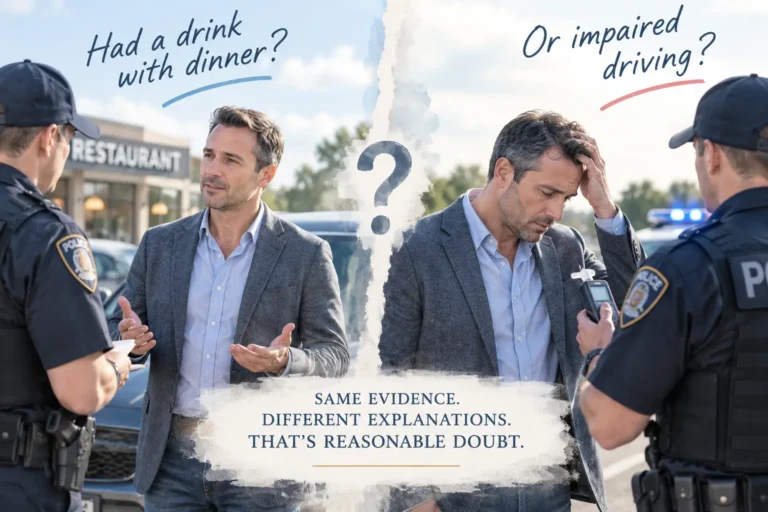
Reasonable Doubt in DUI Cases
Every impaired driving case is different. The DUI lawyers at Charitsis Law have successfully defended hundreds of impaired driving charges by carefully reviewing the evidence and identifying legal issues that can create reasonable doubt.
This case shows how a careful review of the evidence can change the outcome of a DUI charge. Learn more about how our impaired driving lawyers defend DUI charges by examining the evidence, police procedures, breath testing and legal issues that may provide a defence
Nicholas Charitsis is a former Crown Attorney with more than 25 years of criminal law experience. His experience prosecuting and defending criminal cases helps him review the Crown’s evidence from both sides. In a DUI case, he looks closely at the police investigation, breath testing, officer observations and other evidence to identify weaknesses that may create reasonable doubt.
Charged with impaired driving? Speak with Toronto DUI lawyer Nicholas Charitsis before making any decisions. Call 416-731-7113 for a confidential consultation.
The Story: What Actually Happened
At approximately 11:30 p.m. on June 16, 2012, Police Constable Bates of the York Regional Police was on patrol when he noticed a vehicle parked in a lot with its engine running and brake lights engaged. The vehicle was not moving, but something about the scene caused the officer to stop and investigate further.
As he approached the driver’s side door, he saw a man later identified as Mr. Zhang asleep behind the wheel. A pair of shoes was sitting on the hood of the car, adding to the unusual circumstances. The officer tapped on the driver’s window several times with his flashlight, trying to wake him.
After a few attempts, Mr. Zhang woke up. He appeared confused and disoriented, unsure of where he was or what was happening.
The officer asked him to step out of the vehicle
The officer asked him to step out of the vehicle and come back to the police cruiser. At that point, Mr. Zhang began explaining what had happened earlier that night. He told the officer that he had been drinking after breaking up with his girlfriend and admitted that he had consumed alcohol, including a bottle of whiskey in the vehicle and more earlier in the evening.
However, he also made something very clear. He said he knew he should not drive and had already called a friend to pick him up. He even gave the officer his friend’s phone number and said, “Call him, you’ll see.”
Despite this, the officer formed the view that Mr. Zhang was not cooperating. According to the officer’s testimony, Mr. Zhang refused to get out of the vehicle. The officer told the court that he then “removed” him from the car.
What became important later was how that removal actually happened.
What Happened in the Police Vehicle
Mr. Zhang was placed in handcuffs behind his back and escorted to the police cruiser. He was then seated in the back seat in an awkward position, with his legs turned outward and his feet on the pavement outside the vehicle.
Inside the cruiser, the officer made a demand for a breath sample.
Mr. Zhang attempted to comply. He tried to blow into the breathalyzer device, but the position he was in made it difficult. His hands were secured tightly behind his back, his body was twisted, and he was not seated in a normal position for the test.
He was given only a few attempts.
From the officer’s perspective, the samples were not “suitable.” The officer concluded that Mr. Zhang was not properly complying with the demand. As a result, he was charged with refusing to provide a breath sample.
From Mr. Zhang’s perspective, the situation was very different. He believed he was trying his best, but the combination of tight handcuffs and the awkward position made it physically difficult to provide the required breath.
Zhang was charged with care and control while impaired and refusing a roadside breath test.
That difference in perspective became the central issue at trial.
What the Law Says About Refusing a Breath Sample
A charge for refusing to provide a breath sample is treated just as seriously as an impaired driving offence under the Criminal Code of Canada. However, the Crown Attorney must prove more than just a failed test.
To secure a conviction, the Crown must establish beyond a reasonable doubt that:
- A lawful breath demand was made by the police
- The accused understood the demand
- The accused had a reasonable opportunity to comply
- The accused intentionally failed or refused to provide a proper sample
This last point is critical. The law does not punish someone for being unable to comply. It punishes a deliberate refusal.
In many cases, the issue is not whether the test was completed, but whether the accused was actually given a fair chance to complete it. For example, problems can arise where:
- The accused is physically restricted, such as being handcuffed in a way that limits breathing or movement
- The instructions from the officer are unclear or rushed
- The testing environment makes compliance difficult
- The accused attempts to comply but cannot produce a “suitable” sample
In these situations, a careful review of the evidence can reveal that the legal standard has not been met.
As a result, even when the police believe there was a refusal, the court may find that there is reasonable doubt about the accused’s intent. When that doubt exists, the charge cannot result in a conviction.
What Happened at Trial
At trial, the focus shifted from what the officer believed to what the evidence actually proved. The Crown Attorney proceeded on the theory that Mr. Zhang had intentionally failed to provide proper breath samples.
However, the defence carefully tested that assumption.
Nicholas Charitsis challenged the Crown’s case by examining how the breath testing was carried out and whether Mr. Zhang was given a fair and reasonable opportunity to comply.
The evidence showed that:
- Mr. Zhang was handcuffed behind his back before the breath demand was made
- He was seated in the back of the police cruiser in an awkward and restrictive position
- His legs were turned outward, with his feet on the pavement
- He was given only three attempts to provide a proper sample
The defence argued that these conditions made it physically difficult to provide a suitable breath sample. This was not a case of someone refusing to blow. Instead, it raised a real question about whether the accused was able to comply at all.
Mr. Zhang testified at trial and told the court that he tried his best to complete the test. He explained that the handcuffs were tight and that the position he was placed in made it difficult to breathe properly into the device.
What the Judge Decided
The trial judge then had to assess two competing versions:
- The officer’s belief that the accused was not cooperating
- The accused’s evidence that he was trying, but physically unable to comply
In doing so, the court applied the principles from R. v. W.D., which guide how judges assess credibility and determine whether reasonable doubt exists in criminal cases.
Ultimately, the court was not satisfied beyond a reasonable doubt that Mr. Zhang intended to refuse the breath test.
The Result: Not Guilty
After reviewing all of the evidence, the trial judge was left with a clear and important question. Did Mr. Zhang intentionally refuse to provide a breath sample, or was he simply unable to comply under the conditions created by the police?
The court could not say, with certainty, that this was a deliberate refusal.
The judge carefully applied the principles from R. v. W.D. and considered whether the defence evidence raised a reasonable doubt. Mr. Zhang’s testimony, combined with the physical circumstances of the testing, created that doubt.
What the Evidence Showed
The evidence showed that:
- He was handcuffed behind his back during the testing
- He was seated in an awkward and restrictive position
- He attempted to provide samples but struggled to do so
- He was only given a limited number of attempts
As a result, the court was not satisfied beyond a reasonable doubt that he intended to avoid the test.
In Canadian criminal law, if there is reasonable doubt, the accused must be found not guilty. The judge therefore dismissed the charge, and Mr. Zhang was acquitted of refusing to provide a breath sample.
This outcome reinforces a key principle. Even in serious DUI cases, the Crown must prove every part of the offence. Where the evidence leaves room for doubt, the case cannot result in a conviction.
What This Means for Your Case
This case shows how reasonable doubt can arise in DUI cases, even when the police believe there was a refusal. The court does not decide cases based on assumptions. It looks at whether the Crown Attorney can prove each part of the offence with reliable evidence.
In many cases, the key issue is not whether something went wrong, but whether the Crown can prove intent beyond a reasonable doubt.
For example, problems often arise where:
- The accused was not given a fair opportunity to comply with a breath demand
- The testing conditions made it difficult to provide a proper sample
- The instructions were unclear or rushed
- The accused made real efforts but could not complete the test
Each of these issues can weaken the Crown’s case.
These are only some of the legal issues that may provide a defence. Learn more about the defences to impaired driving charges our lawyers examine when reviewing the evidence in a DUI case.
As a result, a charge that may seem strong at first can break down when the evidence is reviewed carefully. A focused defence strategy looks at the details, including timing, positioning, and procedure, to determine whether the legal standard has been met.
Speak With a DUI Lawyer About Your Defence
If you are facing DUI charges, it is important to understand that your case is not decided at the roadside. The outcome depends on the evidence and whether the Crown can prove the case in court.
A criminal defence lawyer can review your disclosure, identify weaknesses in the Crown’s case, and develop a defence strategy aimed at having your charges withdrawn or successfully defended at trial.
Call Charitsis Law at 416-731-7113 to speak with a criminal defence lawyer. Your consultation is confidential, and early advice can make a critical difference in your case.
FAQs About Reasonable Doubt in DUI Cases
Q. What does reasonable doubt mean in a DUI case?
A. Reasonable doubt is the legal standard the Crown Attorney must meet in every criminal case. It means the judge must be sure, based on the evidence, that the accused committed the offence. If there is any real doubt based on logic and common sense, the court must find the accused not guilty.
Q. Can I be convicted if I tried but could not complete the breath test?
A. Not necessarily. The law requires proof that you intentionally refused or failed to comply. If the evidence shows you made genuine efforts but could not complete the test due to positioning, instructions, or physical difficulty, that can create reasonable doubt.
Q. How do courts decide if it was a refusal or an inability to comply?
A. The court looks at all of the evidence, including how the test was conducted, what instructions were given, and how the accused responded. In many cases, the judge compares the officer’s evidence with the accused’s testimony and decides whether the Crown has proven intent beyond a reasonable doubt.
Q. What if the police say I was not cooperating?
A. That is only one part of the evidence. The court must assess whether the officer’s conclusion is supported by the facts. If the circumstances suggest you were trying to comply but could not, the court may reject the idea that it was a refusal.
Q. Can a DUI lawyer help prove reasonable doubt in my case?
A. Yes. A DUI lawyer reviews the disclosure, including officer notes, video evidence, and testing records, to identify weaknesses in the Crown’s case. This may include issues with procedure, timing, or the opportunity you were given to comply. When these issues are properly presented in court, they can lead to reasonable doubt and a not guilty verdict.