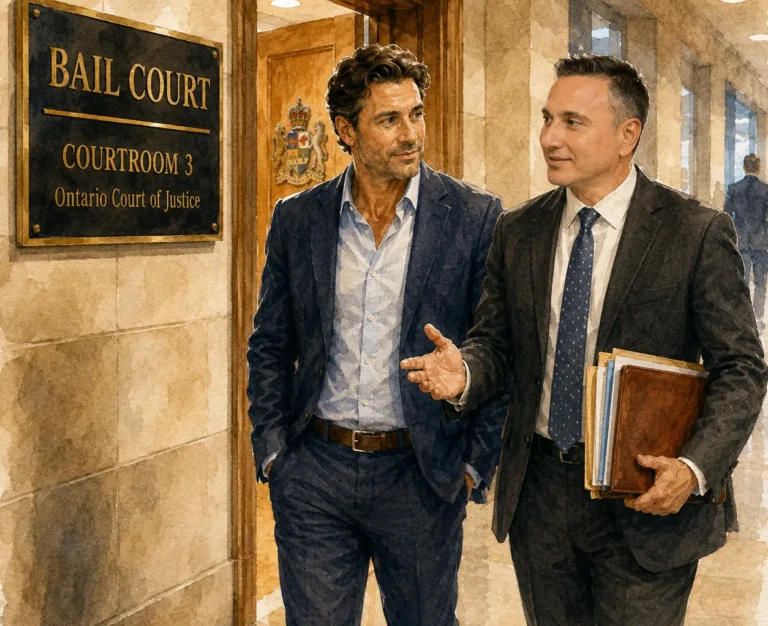
Bail Hearing Lawyers | Bail Release
Getting Released on Bail | Bail Hearing Process | Bail Plans & Sureties | Bail Conditions
If someone you care about has been arrested and held for a bail hearing in Toronto, getting an effective release plan in place quickly can be important. Our team of bail hearing lawyers can help you by representing the accused held in custody, prepare proposed sureties and release plans, negotiate with the Crown Attorney, and represent the accused at the bail hearing to seek their release.
Nicholas Charitsis is a former Crown Attorney with more than 25 years of criminal law experience and has handled over 1,000 bail hearings. He understands how the Crown evaluates a proposed release plan and the issues that can lead to detention.
Available 24/7 for arrests, bail hearings, and urgent advice across the GTA, call Nicholas Charitsis at 416-731-7113.
How Our Bail Hearing Lawyers Help
Our bail hearing lawyers can start preparing for the accused’s release as soon as we are contacted.
Our team of Toronto criminal lawyers will:
- Speak with the accused at the police station, find out what happened and where they are being held
- Identify sureties and prepare them for the bail hearing
- Build a bail plan that addresses the Crown’s concerns
- Present the bail plan to the Crown Attorney and negotiate an agreed release
- Represent the accused if a contested bail hearing is required
Once you call us, we will take care of the bail hearing process, prepare what is needed for the accused’s release, and guide your family through every step until the hearing is completed.
What is a Bail Hearing?
A bail hearing is a court hearing to decide if the accused will be released from custody while awaiting trial.
After an arrest is made the police may decide not to release the accused. Instead, the person is held in custody until they can appear before a Justice for a bail hearing.
In Toronto, bail hearings are held at the Toronto Regional Bail Centre at 2201 Finch Avenue West.
Often, one first learns about the bail hearing through a phone call from the police. The police advise you that a bail hearing is going to be held and the time and date. The police may suggest that you arrange for a bail hearing lawyer to speak for the accused.
Why Do Police Hold Someone for a Bail Hearing?
An accused may be held because police believe they should not be released from custody or because a rule in law requires their release be decided by the court.
Police may hold an accused for a bail hearing when there are concerns about:
- The identity of the accused and whether the accused will attend court when required
- Public safety, including the safety of the complainant or witnesses, including will the accused commit another offence.
- The seriousness and circumstances of the criminal charges, and the law requires the hearing.
- Whether the accused was already on bail, probation, or another court order. Does the accused have a background of offences.
There are also cases where the Criminal Code requires the accused to be brought before the court rather than simply released by police. Some charges also involve a reverse onus, which means the accused must show the court why they should be released.
Being held for a bail hearing does not mean the accused must remain in jail. A strong release plan can address the concerns that led to the detention and help the court decide that the accused can be safely released.
How Does the Bail Hearing Process Work?
If someone is arrested in Toronto and the police decide to hold them for a bail hearing, they will usually remain in police custody until the hearing takes place.
Bail hearings in Toronto are held through the Toronto Regional Bail Centre at 2201 Finch Avenue West.
The people involved may be in different locations:
- The accused will usually remain at the police station and appear at the hearing by video.
- The Justice of the Peace and Crown Attorney are at the Toronto Regional Bail Centre.
- The bail hearing lawyer and proposed sureties can participate remotely by Zoom for a consent hearing.
Before the hearing, the lawyer can speak with the accused and family members. The lawyer can identify possible sureties, prepare a bail plan, and discuss the accused’s release with the Crown Attorney.
Bail Hearing Questions
What Are the Two Ways a Bail Hearing Can Proceed?
There are two common ways a Toronto bail hearing can proceed:
- Consent release – The Crown agrees to release the accused. The defence and Crown present the release plan and proposed conditions to the Justice of the Peace for approval. Once approved and the required paperwork is completed, the accused can be released from custody.
- Contested hearing – The Crown opposes release. Our bail hearing lawyers can respond to the Crown’s concerns, present a bail plan, and argue why the accused should be released.
What Happens If the Crown Opposes the Release?
When the Crown opposes release, our bail hearing lawyers will focus on the reasons for the Crown’s objection and prepare a plan that addresses those concerns.
- Bail plan – We can explain where the accused will live, who will supervise them, whether a surety is available, and what conditions could help address the Crown’s concerns.
- Contested bail hearing – If an agreement cannot be reached, both sides present their positions. Our lawyers argue for release, and the Justice of the Peace decides whether the accused will be released or kept in custody.
- Special bail hearing – More serious or complicated cases may require a longer hearing. This can happen with serious violent or sexual offences, charges involving serious injury or death, or when the accused has a history of breaking court orders.
As bail hearing lawyers we’ll build a strong release plan, presenting the reasons why the accused can be safely released.
How Soon After an Arrest Is a Bail Hearing Held?
If someone has been arrested and the police do not release them, they must generally be brought before a justice without unreasonable delay and within 24 hours, if a justice is available. If a justice is not available within 24 hours, they must be brought before one as soon as possible.
This does not necessarily mean they will be released or their bail hearing will be completed within 24 hours. More time may be needed to prepare a release plan, arrange a surety, review the allegations, or discuss a possible release with the Crown Attorney.
How Long Can Someone Be Held Before a Bail Hearing?
A bail hearing can be adjourned when more time is needed to prepare. Under section 516 of the Criminal Code, the court generally cannot adjourn the bail hearing for more than three clear days without the accused person’s consent.
Although waiting can be difficult for the accused and their family, additional time can sometimes help the defence. A criminal defence lawyer can use that time to prepare a stronger bail plan, find an appropriate surety, address the Crown Attorney’s concerns, and prepare for a contested bail hearing.
How Does the Court Decide Whether to Grant Bail?
The Justice of the Peace will look at the charges, the accused’s background, the lawyers plan, and the concerns raised by the Crown. The court will consider three main questions:
- Will the accused return to court when required? This is called the primary ground.
- Is there a risk the accused will commit another offence or put someone in danger? This is called the secondary ground.
- Could releasing the accused harm public confidence in the justice system? This is called the tertiary ground.
The bail lawyer can address these concerns by presenting a plan showing where the accused will live, how they will be supervised, and what conditions they are prepared to follow.
What Is a Reverse Onus Bail Hearing?
A reverse onus hearing means the accused must show the court why they should be released.
Normally, the Crown must explain why an accused should be kept in custody. In a reverse onus case, that responsibility shifts to the accused.
Reverse onus can apply in cases involving:
- Serious criminal charges, such as domestic assault charges
- An offence allegedly committed while the accused was already on release
- Breaking bail conditions
A reverse onus does not mean the accused will be denied bail. It means the defence must present a strong plan showing why the accused can be safely released.
What Is a Bail Plan?
A bail plan explains how the accused will live and be supervised if they are released from custody.
Our bail hearing lawyers will work with the accused and family to prepare a plan that addresses the Crown’s concerns. As part of the release plan, we’ll work out:
- Where the accused will live, Who will supervise them, Who may be suitable to act as a surety
- Whether work, school, counselling, or treatment should be part of the plan
- What bail conditions could be proposed
- Whether no-contact or stay-away conditions may be required
What Are Bail Conditions?
Bail conditions are rules the accused must follow after being released from custody while their criminal case is before the court.
The conditions will depend on the charges and the concerns in the case. They may include:
- No contact with a complainant or other named person
- Staying away from certain homes, workplaces, or other locations
- Living at an approved address or following a curfew
- Not possessing weapons
- Restrictions on alcohol, drugs, or driving
- Reporting to a bail supervisor or following the directions of a surety
For example, someone charged with domestic assault may face strict no-contact and stay-away conditions. A person facing impaired driving charges may have conditions involving no alcohol or driving.
Breaking bail conditions can result in a new criminal charge, another arrest, and another bail hearing. In any subsequent hearing the Crown may request the accused be kept in custody or that stricter conditions be imposed.
What Is a Surety and What Does a Surety Do?
A surety is someone who agrees to help supervise the accused while they are on release from bail. A surety is often a family member, spouse, or close friend who knows the accused well.
A surety is responsible for:
- Helping make sure the accused follows their bail conditions
- Making sure the accused attends court when required
- Supervising the accused as required by the bail plan
- Reporting a serious breach of the bail order
- Pledging an amount of money to the court
Not every person needs a surety to be released. Whether one is needed can depend on the charges, the accused’s criminal record, previous problems while on release, the Crown’s concerns, and the strength of the proposed bail plan.
What Makes a Good Surety for a Bail Hearing?
A good surety is someone who knows the accused well, has good judgment, and can realistically supervise them while they are out on bail.
The court may want to know:
- Your relationship with the accused, how long you have known them, and why you believe they will listen to you
- Where the accused will live and how often you will see or speak with them
- Your work schedule and how you will realistically supervise the accused
- Whether you have a criminal record and your ability to make a financial pledge
A surety must understand the bail conditions and be prepared to make sure they are followed. You should not agree to supervise someone if you cannot realistically do it.
Before the hearing, our bail hearing lawyers at Charitsis Law will prepare the proposed surety, explain their responsibilities, and review the questions they may be asked in court.
What Are the New Bail Rules in Ontario?
Ontario changed its bail rules on August 17, 2026, including new requirements for money pledged by a surety. These rules have been subsequently contested in court and may or may not be in effect when your bail hearing is scheduled.
- Do I have to deposit the money? If the release order requires a surety to promise a specific amount of money, that amount must now be deposited within two business days after the accused is released. Payment can be made by cash, money order or bank draft.
- What happens if the accused breaks their bail? The money is not automatically lost. A court can determine whether some or all of the security should be forfeited because of a default under the release order.
- Do I get the money back? If the release order ends without a certificate of default, the surety is entitled to have the full deposit returned. If a judge orders only part of the money forfeited, the remaining amount can be returned.
These new rules can involve a significant financial commitment for a surety. Our bail hearing lawyers can explain how much money must be deposited, when it must be paid, and what could put that money at risk before someone agrees to act as a surety.
Can Family Members Participate in the Hearing?
Family members can help our bail hearing lawyers prepare the release plan and may be able to watch or participate in the hearing.
At a bail hearing the family maybe expected to:
- Provide information about where the accused will live and how they can be supervised
- Act as a surety if one is required if they are suitable
- Attend or observe the hearing, depending on how the bail hearing is being held
If someone you care about has been arrested, our bail hearing lawyers will find out where they are being held, speak with them, and advise you what we need to do to prepare for the hearing.
What Happens Once Bail Is Granted?
When bail is granted, the accused is released from custody, once the release order and required paperwork are completed.
Before being released, the accused will be told the bail conditions they must follow. These may include a curfew, living at a specific address, no-contact conditions, or supervision by a surety.
What Happens If Bail Is Denied?
If bail is denied, the accused will remain in custody while the criminal case continues, but the original decision may be reviewed.
Our lawyers can review what happened at the hearing, why release was refused, and advise you as to if there are grounds to bring a review before a higher court.
What Is a Bail Review?
A bail review asks the Ontario Superior Court of Justice to review an earlier decision to keep the accused in custody.
Our bail hearing lawyers can examine the original hearing and determine whether there is a basis to ask the court to reconsider a release. This may include:
- An error made during the original hearing or in the decision
- A significant change in circumstances since bail was denied
- New information that could affect whether the accused should be released
- Changes that address problems with the original bail plan
A bail review is not simply another chance to have the same bail hearing again. There must be a reason in law or new circumstances that the court should be made aware of.
Speak With a Toronto Bail Hearing Lawyer Today
You’ll speak directly with Nicholas Charitsis—not a call centre or an intake representative.

When you call Charitsis Law, you’ll speak directly with Nicholas Charitsis. He’ll answer your questions, explain your legal options, and help you understand the evidence against you.
Call 416-731-7113 today to arrange your confidential case review.
FAQs about Toronto Bail Hearings
Q. How Soon Does a Bail Hearing Take Place After an Arrest?
A. If the police decide to hold the accused in custody, they must generally be brought before a Justice of the Peace within 24 hours of the arrest, if a justice is available, or as soon as possible afterward.
The actual timing of the bail hearing can depend on the court schedule, the criminal charges, whether the Crown Attorney opposes release, and whether more time is needed to prepare a release plan or suitable surety.
Because bail hearings can happen quickly, it is important to contact us as soon as you learn that the accused is being held in custody. This gives the lawyer time to prepare for the hearing and work toward the accused’s release.
Q. Can Someone Be Released Without a Bail Hearing?
A. Yes. In many cases, police can release an accused directly from the police station without requiring a bail hearing.
Whether the accused is released by police depends on the criminal charges and the circumstances of the case. Police may decide to hold the accused because of concerns about public safety, attending court, protecting witnesses or evidence, or the accused being subject to another court order.
In some cases, the Criminal Code requires the accused to be brought before a Justice of the Peace to decide whether they should be released. This can include certain reverse onus situations.
Q. Do I Need a Lawyer for a Bail Hearing in Ontario?
You are not required to hire a private lawyer for a bail hearing, but having an experienced bail hearing lawyer can make the difference between being released and sitting in jail.
It’s never considered wise to represent yourself in court. You may not be able to comprehend the nuances of criminal law, the Crown’s concern, and how the judge might perceive you and the charges against you. Having an experienced lawyer can make all the difference.
Q. What Is the New Bail Law in Canada?
A. Canada changed its bail laws in 2026 through the Bail and Sentencing Reform Act, also known as Bill C-14. Most of the new bail rules came into force on July 15, 2026.
The changes make bail more difficult in certain cases involving repeat or violent offending and expand the situations where a reverse onus applies. Courts must also consider additional factors, including serious or numerous outstanding charges, random or unprovoked violence, and the strength of the bail plan in reverse onus cases.
The new law also places additional restrictions on who can act as a surety. Our bail hearing lawyers will consider the current bail laws when preparing a plan for release. The law is currently being contested and may not be in force at the time of your hearing.
Q. What Are Ontario’s New Cash Bail Rules?
Ontario introduced new bail security rules that came into effect on August 17, 2026.
When a release order requires an accused or surety to promise a specific amount of money, that amount must now be deposited within two business days after the accused is released. The payment can be made by cash, money order or bank draft.
The money can be returned when the release order ends if there has been no default requiring forfeiture. If the court orders some of the money forfeited, only the remaining amount is returned.
Ontario also strengthened its ability to collect unpaid bail debts and can register a lien against real estate in certain circumstances.
Our bail hearing lawyers can explain how these new rules apply to the proposed release plan and what financial commitment may be required from the accused or surety.
These new rules for bail hearings are currently being challenged in the Ontario court system, so they may or may not apply at your time of reading.
About Bail Lawyer Nicholas Charitsis
Nicholas Charitsis is a Toronto criminal lawyer and former Crown Attorney with more than 25 years of experience representing accused persons at bail hearings.
Nicholas has appeared at more than 1,000 bail hearings during his career. He has extensive experience dealing with Crown Attorneys and appearing before Justices of the Peace in Toronto bail court.
His bail hearing experience includes preparing release plans, working with sureties, addressing Crown concerns, and presenting arguments for the accused to be released from custody.
Nicholas also serves as Chair of an Ontario committee involved in recommending candidates for Justice of the Peace appointments. His combination of courtroom experience, former Crown experience, and more than 25 years practising criminal law provides clients with experienced legal representation when preparing for a bail hearing.
If someone you know is being held for a bail hearing, call Nicholas Charitsis directly at 416-731-7113.