
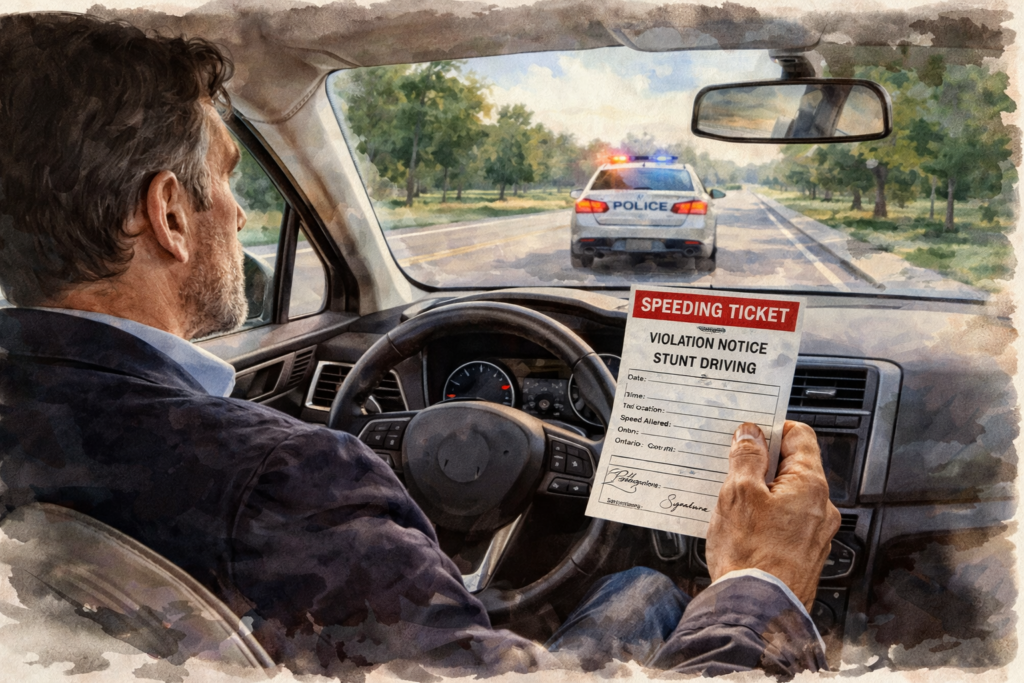
Stunt Driving Lawyers in Ontario
As stunt driving lawyers, we help Ontario drivers deal with one of the most serious traffic charges.
If you have been charged with this offence, you should speak with a lawyer right away. The penalties are significant, and how your case is handled early can make a real difference.
What our stunt driving lawyers do for you:
- Advice and representation: Clear, honest advice is provided from the start. You understand what to expect and what opportunities may be available in your case.
- Defence preparation: The evidence is reviewed in detail. Pre-trial meetings are conducted with the prosecutor. A clear strategy is built based on the facts of your case.
- Trials: Where the matter goes to trial, we appear in court on your behalf. In many cases, your attendance is not required, and the defence is presented clearly and effectively.
Stunt driving charges can carry lasting consequences, but the right approach can change the outcome. Our stunt driving lawyers focus on clear advice, strong defence strategies, and practical steps to help you move forward.
Charged with DUI in Newmarket? Speak with a criminal defence lawyer. Call 647-930-0200.
What Is Stunt Driving?
Stunt driving is a serious offence under section 172 of the Ontario Highway Traffic Act. The offence is a traffic ticket under provincial law vs criminal charges under federal law e.g the Criminal Code of Canada. It includes a wide range of driving behaviours that are considered dangerous or aggressive, even if no accident occurs.
In many cases, drivers are charged with stunt driving without realizing how broad the definition is. The law focuses on how the driving is perceived and whether it creates a risk to public safety.
Common examples of stunt driving include:
- Excessive speed: Driving 40 km/h or more over the speed limit on roads under 80 km/h, or 50 km/h or more over on highways.
- Racing: Competing with another vehicle or attempting to outpace traffic.
- Aggressive driving: Sudden lane changes, cutting off other vehicles, or driving too closely.
- Loss of traction: Spinning tires, drifting, or intentionally causing the vehicle to lose control.
- Performing stunts: Actions such as lifting tires off the road or using the vehicle in a way not intended for normal driving.
Ontario Regulation 455/07 sets out the detailed definition of races, contests, and stunts under Ontario law. For a complete list of conduct that may qualify as stunt driving, review Ontario Regulation 455/07.
Is Stunt Driving a Criminal Charge?
Stunt driving is not a criminal charge, but it is treated very seriously under Ontario traffic law. It falls under the Highway Traffic Act and can still lead to severe penalties that affect your licence, your record, and your future.
In many cases, people are surprised to learn that even though this is not part of the Criminal Code, the court process can feel very similar. You will still attend court, deal with a prosecutor, and face penalties that can have long-term consequences.
What makes this charge serious:
- Court process: You are required to attend court and respond to the charge. The case is handled by a prosecutor and follows a structured legal process.
- Driving record: A conviction goes on your driving record for 3 years and will dramatically affect your insurance rates.
- Significant penalties: The court can impose large fines, long licence suspensions, and in some cases, jail time.
Even though stunt driving is not a criminal offence, the impact can be substantial. As a result, many drivers choose to work with stunt driving lawyers to understand their options and build a defence strategy early in the process.
Penalties for Stunt Driving
As stunt driving lawyers, we regularly help drivers understand the full impact of these charges and what may happen next. Many people first notice the immediate penalties at the roadside, but the more serious consequences are decided later through the court process. As traffic ticket lawyers, we focus on how these penalties can be challenged or reduced.
At the roadside, your licence can be suspended right away and your vehicle can be impounded. However, the court has the authority to impose much more significant penalties depending on the facts of the case.
What you may face if convicted:
- Licence suspension: The court can impose a longer suspension after conviction. This can affect your ability to work and manage daily responsibilities.
- High fines: Fines are often in the thousands of dollars. Additional costs and surcharges can increase the total amount.
- Jail time: In more serious cases, a jail sentence is possible. This depends on the circumstances and your driving history.
- Insurance impact: Insurance companies may increase your rates significantly. In some cases, coverage may be denied.
- Driving record: A conviction stays on your record and can affect future driving privileges and opportunities.
As lawyers dealing with stunt driving charges, the focus is always on limiting these outcomes wherever possible. The right defence strategy can make a meaningful difference in how your case is resolved.
Call 647-930-0200 to speak directly with a lawyer. Your call is free and confidential.
How Stunt Driving Charges Are Proven in Court
As stunt driving lawyers, we focus on how the charge is built and whether the evidence supports it. In many cases, the outcome depends on what the officer observed and how that evidence is presented in court. As traffic ticket lawyers, we look closely at every detail to determine if the case can be challenged.
The Crown must prove the allegation using evidence. This often includes both the officer’s observations and any supporting technical evidence.
What the court will look at:
- Officer observations: The officer may describe speed, driving behaviour, and road conditions. These observations often form the foundation of the case, The officer may have used radar or paced the motor vehicle or simply going upon what he observed.
- Speed evidence: Radar or lidar readings may be used to support allegations of excessive speed. The accuracy and use of these devices can be challenged. The officer must be able to testify that he had a clear unobstructed view and he never lost sight of the vehicle.
- Driving behaviour: Actions such as rapid lane changes, racing, or loss of control may be relied on to support the charge.
- Road and traffic conditions: The surrounding environment, traffic flow, and weather conditions can all be relevant to how the driving is interpreted.
As lawyers dealing with stunt driving charges, the focus is on identifying weaknesses in this evidence. A careful review can reveal issues that may lead to a reduced charge or a withdrawal.
How Stunt Driving Lawyers Fight the Charge
As stunt driving lawyers, we focus on finding weaknesses in the case and building a defence that can lead to a reduced charge or a withdrawal. Not every stunt driving charge is as strong as it first appears. As traffic ticket lawyers, we look closely at how the evidence was gathered and whether it meets the legal standard required in court.
Each case is different, and the defence depends on the specific facts. Small details can make a significant difference in how the case is resolved.
What this may involve:
- Reviewing the stop: The reason for the traffic stop is examined. If the stop was not lawful, the case may be challenged.
- Challenging speed evidence: Radar or lidar readings are analyzed. Errors in use or calibration can weaken the case.
- Questioning observations: Officer notes and recollection are reviewed carefully. Inconsistencies can affect reliability.
- Analyzing disclosure: All evidence provided by the prosecutor is examined. Missing or incomplete disclosure can impact the case.
As lawyers dealing with stunt driving charges, the goal is always to identify opportunities to challenge the evidence. A strong defence strategy can change the direction of the case and improve the outcome.
The Court Process for Stunt Driving Charges
As stunt driving lawyers, we guide you through each step of the court process so you know what to expect.
Most importantly, we attend court on your behalf so you do not have to manage the process on your own. As traffic ticket lawyers, we focus on keeping things simple and efficient for you.
After a charge is issued, your case moves through several stages before it is resolved.
What the court process typically involves:
- First appearance: We appear in court on your behalf and handle the first court date for you. In most cases, you do not need to attend, which allows you to continue your daily routine without disruption.
- Disclosure: The prosecutor provides the evidence, including officer notes and any supporting material. This information is reviewed carefully to understand the strength of the case and identify any issues.
- Pre-trial discussions: Meetings are held with the Crown Attorney to review the evidence and discuss possible outcomes. These discussions can often lead to a resolution before the matter reaches trial.
- Trial scheduling: If the case is not resolved, a trial date is scheduled by the court. The timeline can vary depending on the court location and the complexity of the case.
- Trial: In many situations, your attendance is only required if the matter proceeds to trial and your input is needed. We’ll discuss this and have a pre-trial meeting with you as the case moves through the court system.
As lawyers dealing with stunt driving charges, the goal is to move your case forward efficiently while identifying opportunities to resolve it as early as possible.
What Results Are Possible in Stunt Driving Cases
As stunt driving lawyers, we focus on outcomes and what can realistically be achieved in your case. Every situation is different, and the result depends on the evidence, the facts, and how the case is handled. As traffic ticket lawyers, we look for opportunities to improve the outcome at every stage.
Not every stunt driving charge leads to a conviction. In many cases, there are options available depending on the strength of the evidence.
Possible outcomes may include:
- Charge withdrawn: The charge may be dropped entirely if there are issues with the evidence. This means no conviction is registered.
- Charge reduced: The allegation may be reduced to a lesser offence, such as speeding. This can significantly lower the impact on your record and insurance.
- Resolution before trial: The matter may be resolved through discussions with the Crown Attorney. This can avoid the need for a full trial.
- Trial outcome: If the case proceeds to trial, the charge must be proven in court. If it is not proven, you are found not guilty.
As lawyers dealing with stunt driving charges, the focus is always on finding the best possible result based on your situation. Call today and discuss your case with a lawyer for stunt driving charges.
Why Work with Stunt Driving Lawyers
As stunt driving lawyers, we understand how these charges are handled across Ontario courts and what it takes to build a strong defence. Choosing the right legal representation can make a real difference in how your case is resolved. As traffic ticket lawyers, our focus is on clear advice, efficient handling, and results that matter.
What sets our approach apart:
- Focused experience: This is what we do, motor vehicle law. We deal with cases regularly across Ontario courts. This allows for a clear understanding of how prosecutors approach stunt driving charges and how to respond effectively, and the legal arguments and strategies that work.
- Clear communication: You receive straightforward advice from the start. You understand your options, the process, and what to expect at each stage.
- Efficient process: Court appearances and case management are handled on your behalf. This helps reduce stress and keeps your case moving forward without delays.
- Results-driven approach: Every step is taken with the goal of improving the outcome. Opportunities to reduce or withdraw the charge are identified and pursued early.
As lawyers dealing with stunt driving charges, the goal is to provide practical guidance and a strong defence from start to finish. The right approach can change how your case moves forward and how it ultimately ends.
Speak with Stunt Driving Lawyers Today
If you are facing a stunt driving charge, get clear answers and a plan right away. Call 647-930-0200 to speak directly with a lawyer. Your call is free and confidential.
FAQs from our Stunt Driving Lawyers
As stunt driving lawyers, we regularly answer important questions from drivers across Ontario. These answers are designed to give you clear, practical guidance so you understand your situation and what to do next.
Q. Do I have to go to court for a stunt driving charge?
A. In most cases, you do not have to attend the early court appearances yourself.
As your stunt driving lawyer, we appear in court on your behalf and handle the process for you. This includes the first appearance, receiving disclosure, and attending pre-trial meetings with the Crown Attorney.
Your attendance is usually only required if the matter proceeds to trial or if your input is needed for specific issues. This allows you to continue your daily routine while your case is being handled properly.
Q. Can a stunt driving charge be reduced?
A. Yes, depending on the strength of the evidence, a stunt driving charge may be reduced to a lesser offence such as speeding.
As traffic ticket lawyers, we review how the charge was laid, how speed was measured, and whether the officer’s observations support the allegation. If weaknesses are identified, this can create opportunities to resolve the matter with a reduced charge or, in some cases, a withdrawal.
Each case is different, and the outcome depends on the facts and the available evidence.
Q. How long does a stunt driving case take?
A. The timeline can vary depending on the court and how the case progresses. Some cases resolve early through pre-trial discussions with the provincial prosecutor, while others may take several months if they proceed to trial.
As stunt driving lawyers, we focus on moving your case forward efficiently while reviewing the evidence and identifying opportunities to resolve it as early as possible. Time can many times work to your advantage with traffic tickets in Ontario. While the ticket is in the court system, its not on your driving record or insurance.
Q. Will a stunt driving charge affect my insurance?
A. Yes, a conviction can have a serious impact on your insurance. Insurance companies often treat stunt driving as a high-risk offence, which can lead to significantly higher premiums or difficulty obtaining coverage. In some cases, drivers may need to seek high-risk insurance providers.
As lawyers dealing with stunt driving charges, reducing or avoiding a conviction can make a meaningful difference in limiting these long-term financial consequences.
Q. What should I do after being charged with stunt driving?
A. The most important step is to speak with our stunt driving lawyers as soon as possible.
Early advice helps you understand the charge, the court process, and the options available in your case. Avoid making assumptions or taking action (read making mistakes) without understanding the full situation.
A proper review of the evidence and a clear defence strategy from the start can improve your chances of achieving a better outcome.