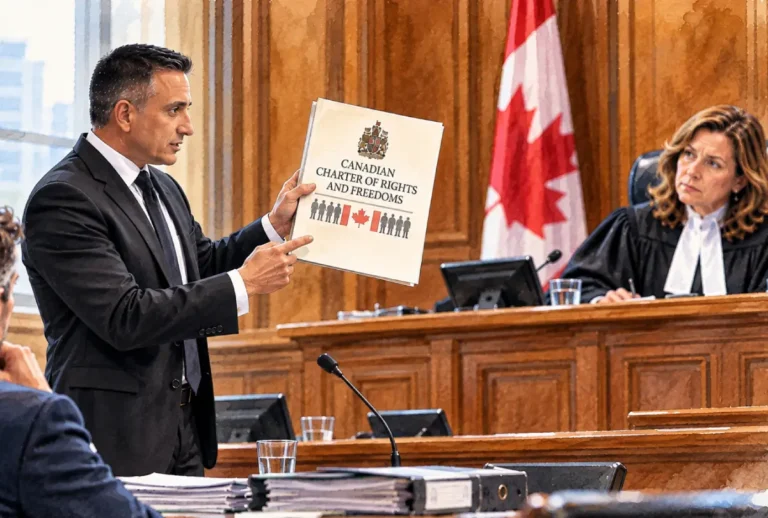
What Are Your Charter Rights When Facing Criminal Charges?
If you are arrested or charged with a crime in Ontario, the Canadian Charter of Rights and Freedoms protects your legal rights. Some of the most important protections include:
- Your right to remain silent: You generally do not have to answer police questions about an alleged crime.
- Your right to speak with a lawyer: Police must inform you of this right when you are arrested or detained.
- Protection against unlawful searches: Police must have legal authority to search you, your vehicle, or your home.
You also have the right to a fair trial and are presumed innocent until proven guilty. If police violate your Charter rights, important evidence could be excluded from court. In some cases, this can lead to criminal charges being withdrawn or dismissed.

If you are facing criminal charges and believe your Charter rights were violated, Toronto criminal lawyer Nicholas Charitsis can review your case.
As a former Crown Attorney with more than 20 years of criminal law experience, Nicholas knows how to examine police conduct and identify possible Charter violations. Call 416-731-7113 to discuss your charges and find out whether a Charter violation could help you fight your case.
Section 7: Your Right to Life, Liberty and Security
Section 7 of the Canadian Charter protects your right to life, liberty, and security of the person. It also requires the justice system to follow the principles of fundamental justice.
When you are facing criminal charges in Ontario, these protections help ensure you receive a fair legal process.
Your rights include:
- The right to make full answer and defence: You must have a fair opportunity to challenge the criminal charges against you.
- The right to Crown disclosure: You are generally entitled to receive relevant evidence in the Crown’s possession or control, including evidence that could help your defence.
- Protection against self-incrimination: The Charter protects you against being forced to provide evidence against yourself, subject to certain legal exceptions.
Can You Get Access to the Crown’s Evidence?
Yes. If you are charged with a criminal offence, the Crown Attorney must generally disclose relevant evidence to the defence.
This can include police reports, witness statements, video recordings, and other evidence collected during the investigation.
Our criminal defence lawyers review this evidence to identify weaknesses in the Crown’s case, possible Charter violations, and opportunities to fight the charges.
Section 8: Protection Against Unreasonable Search and Seizure
Section 8 of the Canadian Charter protects you against unreasonable searches by police. Police must have legal authority to search your home, vehicle, phone, or personal belongings.
In many cases, police need a search warrant. However, some searches are allowed without a warrant.
Can Police Search You Without a Warrant?
Yes, but only in certain circumstances. Police cannot search you simply because they suspect you have committed a crime.
Examples of searches that could violate your Charter rights include:
- Unlawful vehicle searches: Police search your vehicle without proper legal grounds.
- Illegal home searches: Police enter and search your home without a warrant or another lawful reason.
- Cellphone searches: Police search your phone without meeting the legal requirements.
What Happens if Police Conduct an Illegal Search?
If police obtain evidence through an unreasonable search, our criminal defence lawyers can challenge how that evidence was collected.
A judge can exclude evidence obtained through a Charter violation if admitting it would bring the administration of justice into disrepute.
In some criminal cases, excluding important evidence can make it difficult for the Crown Attorney to prove the charges. This could lead to an acquittal or the withdrawal of charges.
Section 9: Protection Against Arbitrary Detention
Section 9 of the Canadian Charter protects you against being detained by police without lawful grounds. Police cannot hold you simply because they have a hunch that you committed a crime.
If police detain you without proper legal grounds, your Charter rights could be violated.
Can Police Stop or Detain You Without a Reason?
Police need lawful authority to detain you. When investigating a crime, they generally need reasonable grounds to suspect that you are connected to a particular offence and that detention is necessary.
Examples of possible Charter violations include:
- Unlawful detention: Police hold you without proper legal grounds.
- Improper investigative stops: Police detain you based on a hunch rather than reasonable suspicion.
- Unnecessary detention: Police continue holding you after the legal grounds for detention no longer exist.
Police also have certain powers to stop vehicles under Ontario traffic laws, even without suspecting a crime. However, these powers have legal limits.
Can an Unlawful Detention Affect Criminal Charges?
Yes. If police detain you unlawfully and obtain evidence during that detention, our criminal defence lawyers can challenge the evidence in court.
A judge can exclude evidence obtained through a Charter violation when the legal test for exclusion is met.
For example, in R. v. Palacios, the court found several Charter violations involving a traffic stop, arrest, and police investigation. The judge excluded the breath test results, and the driver was found not guilty of both impaired driving and driving over 80.
You can also read about a successful impaired driving defence involving the grounds for arrest, where the court dismissed the charge after examining the police evidence.

Section 10: Your Right to Speak With a Lawyer When Arrested or Detained
Section 10 of the Canadian Charter protects your legal rights when police arrest or detain you. Police must tell you why you are being detained and inform you of your right to speak with a lawyer without delay.
These protections include:
- Section 10(a) — Reason for arrest: Police must promptly tell you why you are being arrested or detained.
- Section 10(b) — Right to a lawyer: Police must inform you of your right to legal advice and give you a reasonable opportunity to contact a lawyer.
- Private legal advice: You must generally be allowed to speak with your lawyer in private before police continue questioning you.
Can Police Question You Without a Lawyer?
Police can ask questions, but you generally have the right to remain silent. If you ask to speak with a lawyer after being arrested or detained, police must normally give you a reasonable opportunity to get legal advice before continuing questioning.
However, there are exceptions, including certain roadside investigations.
Learn more about your right to remain silent when questioned by police.
What Happens if Police Deny You Access to a Lawyer?
If police fail to respect your right to counsel, our criminal defence lawyers can challenge evidence obtained during the investigation.
For example, in R. v. Palacios, the court found several Charter violations, including problems with the driver’s right to speak with a lawyer. The judge excluded the breath test results, and the driver was found not guilty of both impaired driving and driving over 80.
A Charter violation does not automatically result in dismissed charges. However, excluding important evidence can seriously weaken the Crown Attorney’s case.
Section 11: Your Rights During a Criminal Trial
Section 11 of the Canadian Charter protects people charged with criminal offences. These rights help ensure that everyone receives a fair trial and that criminal charges are dealt with within a reasonable time.
Some of the most important protections include:
- The right to a trial within a reasonable time (Section 11(b)): Criminal charges must be dealt with without unreasonable delays.
- The presumption of innocence (Section 11(d)): You are innocent until the Crown Attorney proves your guilt beyond a reasonable doubt.
- Protection against double jeopardy (Section 11(h)): You generally cannot be tried again for the same offence after a final acquittal or conviction.
Can Criminal Charges Be Dismissed Because of Court Delays?
Yes. Section 11(b) protects your right to have criminal charges heard within a reasonable time.
The Supreme Court of Canada established guidelines for unreasonable trial delays in R. v. Jordan.
The general time limits are:
- 18 months: Cases proceeding in provincial court without a preliminary inquiry.
- 30 months: Cases proceeding in superior court, or provincial court following a preliminary inquiry.
These limits are not automatic deadlines. Certain delays are deducted, and exceptional circumstances can justify longer proceedings.
If the delay violates your Charter rights, the court can order a stay of proceedings, ending the prosecution.
Learn more about Section 11(b) applications and unreasonable court delays in Ontario.
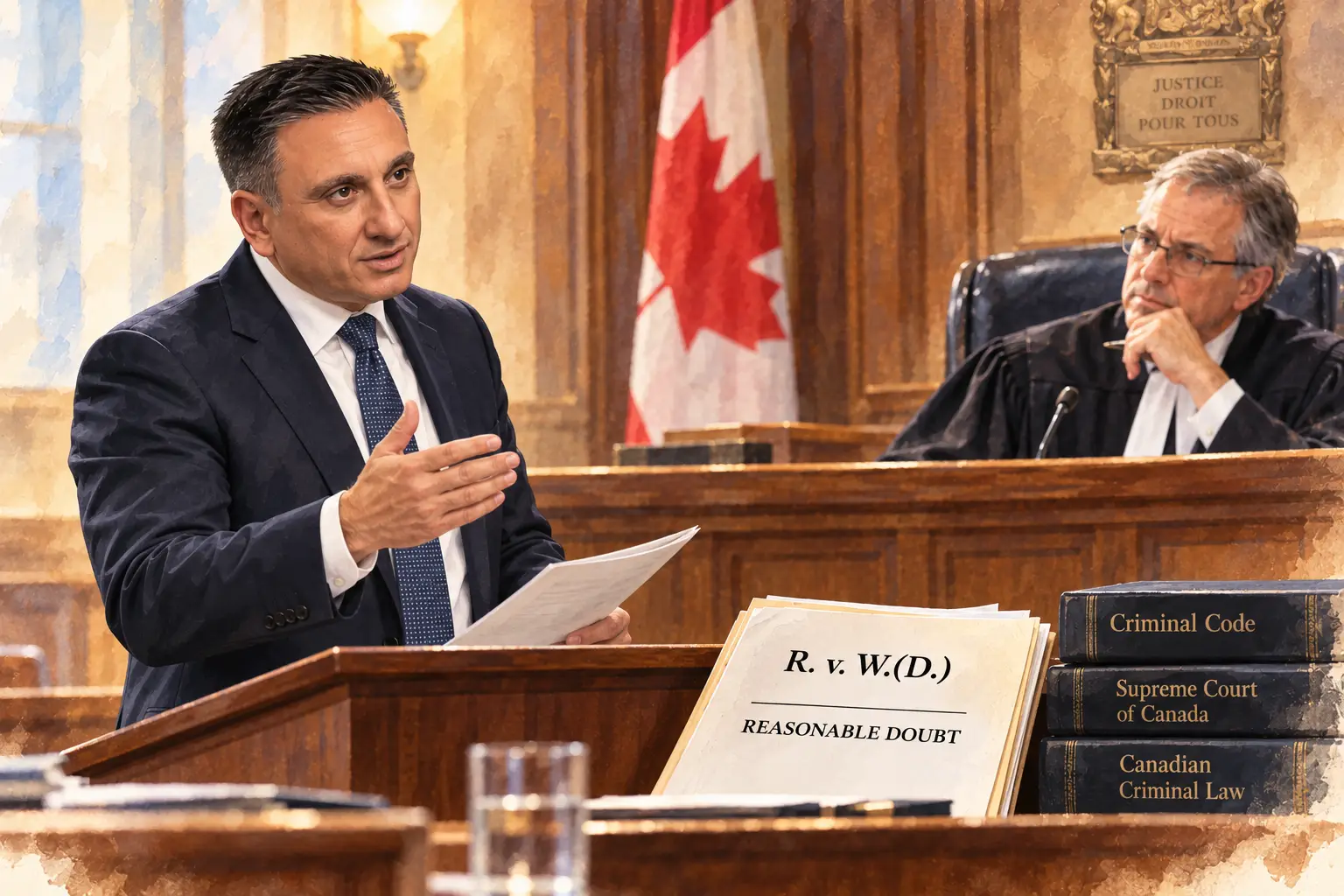
How Does the Presumption of Innocence Protect You?
You do not have to prove that you are innocent. The Crown Attorney must prove every essential element of the criminal charge beyond a reasonable doubt.
Our criminal defence lawyers examine the evidence, question its reliability, and challenge weaknesses in the Crown’s case.
If the Crown cannot prove the charge beyond a reasonable doubt, the court must find you not guilty.
Section 24: What Happens When Police Violate Your Charter Rights?
Section 24 of the Canadian Charter allows courts to provide remedies when someone’s Charter rights have been violated.
Depending on the circumstances, a Charter violation can result in:
- Evidence being excluded: A judge can prevent the Crown Attorney from using evidence obtained through a Charter violation.
- Criminal charges being stayed: In exceptional cases, a judge can order a stay of proceedings, ending the prosecution.
- Other legal remedies: A court can grant another remedy that is appropriate and just in the circumstances.
Can a Charter Violation Get Criminal Charges Dismissed?
Yes. A Charter violation can sometimes lead to criminal charges being withdrawn, stayed, or ending in an acquittal. However, a violation does not automatically mean the charges will be dismissed.
Under Section 24(2), a judge must exclude evidence obtained in a manner that violated Charter rights if admitting it would bring the administration of justice into disrepute.
For example, if police unlawfully obtain important evidence during a DUI investigation, our criminal defence lawyers can ask the court to exclude that evidence.
If the evidence is excluded, the Crown Attorney might no longer have enough evidence to prove the charge.
How Do Judges Decide Whether to Exclude Evidence?
The Supreme Court of Canada established a three-part test in R. v. Grant. Judges consider:
- The seriousness of the Charter violation: How serious was the police misconduct?
- The impact on your rights: How much did the violation affect your protected interests?
- The public interest in a trial on the merits: How important is it for the court to decide the case using the available evidence?
The judge weighs these factors to decide whether admitting the evidence would harm public confidence in the justice system.
Our Toronto DUI lawyers examine police investigations, arrest procedures, and breath test evidence to identify possible Charter violations that could affect impaired driving charges.
How Does a Charter Application Work in Ontario?
A Charter application is a legal request asking the court to address a violation of your rights under the Canadian Charter of Rights and Freedoms.
If police violated your rights during an investigation or arrest, our criminal defence lawyers can bring a Charter application to challenge the evidence or seek another legal remedy.
What Happens During a Charter Application?
The process generally involves five steps:
- Reviewing the evidence: Our criminal defence lawyers examine police reports, witness statements, videos, and other Crown disclosure for possible Charter violations.
- Identifying the violation: We determine which Charter rights were potentially violated and how the violation affected your case.
- Filing the application: We prepare the required legal documents and give notice to the Crown Attorney and court, following the applicable court rules.
- Presenting the evidence: At a Charter hearing, the judge can hear testimony and legal arguments from both sides.
- The judge’s decision: The judge decides whether a Charter violation occurred and whether evidence should be excluded or another remedy granted.
Does a Charter Application Happen Before or During a Criminal Trial?
A Charter application can be heard before or during a criminal trial, depending on the issue and the court’s procedures.
In Ontario, the timing and notice requirements depend on whether the case is proceeding in the Ontario Court of Justice or the Superior Court of Justice.
Some Charter applications are decided through a separate hearing. Others are dealt with as part of the trial.
Can a Charter Application Help You Fight Criminal Charges?
Yes. A successful Charter application can sometimes result in important evidence being excluded from court.
For example, problems with police conduct or access to legal advice can affect an impaired driving prosecution.
In R. v. Palacios, Charter violations led to the exclusion of breath test evidence, and the accused was found not guilty of impaired driving and driving over 80.
Our criminal defence lawyers examine the evidence to determine whether a Charter application could help you fight your criminal charges.
How Our Toronto Criminal Lawyers Challenge Charter Violations
At Charitsis Law, our Toronto criminal lawyers examine police investigations to identify possible violations of your Charter rights. A Charter violation can sometimes provide grounds to challenge important evidence and fight criminal charges.
As a former Toronto Crown Attorney with more than 20 years of criminal law experience, Nicholas Charitsis understands how police investigations are conducted and how the Crown Attorney builds a criminal case.
Our criminal defence lawyers review:
- Police conduct: Whether officers had lawful grounds to stop, detain, search, or arrest you.
- Your right to counsel: Whether police informed you of your right to speak with a lawyer and provided a reasonable opportunity to obtain legal advice.
- The evidence: Whether police obtained evidence in violation of your Charter rights and whether it can be challenged in court.
Can a Charter Violation Help You Fight Criminal Charges?
Yes. If police violated your Charter rights, Nicholas Charitsis can examine whether there are grounds to bring a Charter application.
Depending on the circumstances, a successful application could result in evidence being excluded, weakening the Crown Attorney’s case. In some cases, this can lead to criminal charges being withdrawn or an acquittal at trial.
If you have been arrested or charged with a criminal offence in Ontario, you might have grounds to challenge the police investigation.
Call Charitsis Law at 416-731-7113 to speak with Nicholas Charitsis about your charges. Our criminal defence lawyers can review the evidence, identify possible Charter violations, and explain how those violations could help you fight your case.
Speak With Nicholas Charitsis About Your Charter Rights
If you have been arrested or charged with a criminal offence in Ontario, you might have grounds to challenge the police investigation.

Call Charitsis Law at 416-731-7113 to speak with Nicholas Charitsis about your charges.
Our criminal defence lawyers can review the evidence, identify possible Charter violations, and explain how those violations could help you fight your case.
Frequently Asked Questions About Charter Rights in Ontario
What Are My Charter Rights If I Am Arrested in Ontario?
If police arrest you in Ontario, you have the right to know why you are being arrested, the right to remain silent, and the right to speak with a lawyer without delay. Police must generally give you a reasonable opportunity to contact a lawyer. These rights are protected by the Canadian Charter of Rights and Freedoms.
Do I Have to Answer Police Questions in Canada?
Generally, no. You have the right to remain silent when police question you about a suspected crime. However, certain laws require you to provide information in specific situations, such as identifying yourself during a lawful traffic stop. Learn more about your right to remain silent in Canada.
Can Police Search My Phone Without a Warrant?
In most cases, police need a warrant or other lawful authority to search your cellphone. Limited exceptions exist, including certain searches following a lawful arrest. If police searched your phone without proper legal grounds, Nicholas Charitsis can review whether your Charter rights were violated.
Can Police Question Me Without a Lawyer Present?
Yes. In Canada, you generally have the right to consult a lawyer after being arrested or detained, but not to have a lawyer present throughout police questioning. Police must normally give you a reasonable opportunity to obtain legal advice before questioning continues. Certain exceptions apply, including some roadside investigations.
Can Criminal Charges Be Dismissed if Police Violate My Charter Rights?
Yes, but not automatically. A Charter violation can sometimes result in evidence being excluded from court. If the Crown Attorney cannot prove the charge without that evidence, the prosecution could end in an acquittal or withdrawal of charges. In exceptional cases, a court can order a stay of proceedings.
How Do I Know if Police Violated My Charter Rights?
A Charter violation is not always obvious. It can involve an unlawful search, improper detention, denial of access to a lawyer, or other police conduct that breaches your constitutional rights.
At Charitsis Law, Nicholas Charitsis reviews police reports, witness statements, video recordings, and other evidence to identify possible Charter violations. If you believe your rights were violated, call 416-731-7113 to discuss your criminal charges and possible defence options.