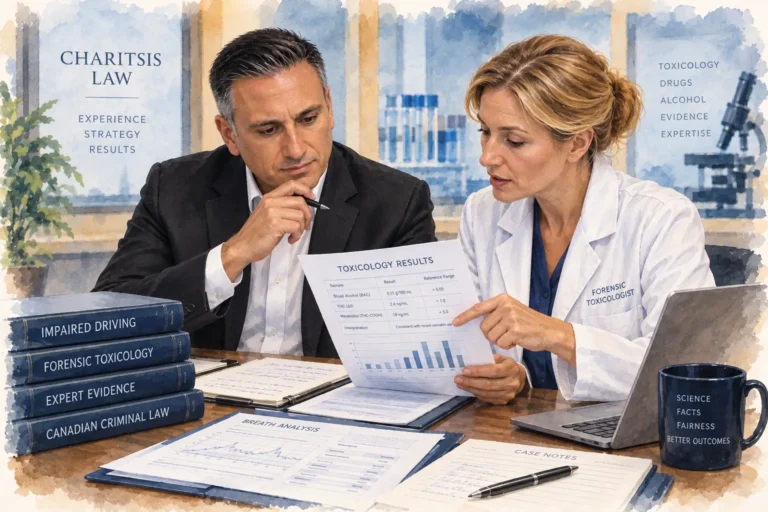
Expert Witnesses in Impaired Driving Defence
How expert witnesses can challenge police evidence in impaired driving cases.
Expert witnesses may be used in impaired driving cases when the evidence involves specialized scientific, medical, or technical issues.
As Toronto impaired driving lawyers, we may consider experts to examine breath or blood alcohol evidence, drug impairment, medical issues, accident evidence, or other evidence relied on by the Crown Attorney.
Nicholas Charitsis is a former Toronto Crown Attorney with more than 25 years of criminal law experience and 350+ five-star Google reviews. His years of experience fighting impaired driving charges helps him identify when expert evidence may be useful, what evidence should be examined, and how expert findings may affect the defence strategy.
If you’ve been charged with impaired driving, call Nicholas Charitsis at 416-731-7113 to discuss what happened and how we can help you.
When Is an Expert Witness Needed?
An expert witness may be needed when an drinking and driving case involves scientific, medical, or technical evidence that requires specialized knowledge. The purpose is not simply to disagree with the Crown Attorney.
The experts job is to examine the evidence and provide an independent opinion about an issue that may affect the case.
Where an Expert Witness Maybe Used
Expert evidence may be considered when a case involves:
- Breath or blood alcohol results
- Drug or toxicology evidence
- Medical conditions that may affect signs of impairment
- The reliability or interpretation of scientific evidence
- A collision requiring accident reconstruction
- Other technical evidence beyond ordinary knowledge
Not every impaired driving case requires an expert. A criminal defence lawyer must first review the disclosure and determine whether there is a specific issue where specialized evidence could assist the defence.
Toxicologists and Alcohol Evidence
A toxicologist is one of the most common experts used in DUI cases.
The toxicologist provides an independent assessment of the alcohol evidence, including the breath alcohol readings obtained by police and the conclusions being relied on by the Crown Attorney.
A toxicologist may also examine the timing of alcohol consumption and provide an opinion about a person’s blood alcohol concentration (BAC) at an earlier time. This can become important when considering the two-hour period used in Canada’s impaired driving laws and whether the alcohol readings accurately reflect the relevant time.
The expert would also review the breath-testing records, procedures, and documentation prepared by the police breath technician. This may help identify technical or scientific issues with the testing process or with the conclusions drawn from the breathalyzer results.
Where the defense lawyer believes the toxicologist has evidence that might might bring the breathalyzer testing into question question or create a reasonable doubt, the toxicologist would usually appear in court and testify before the judge.
The toxicologist and all expert witnesses for the defence would be a paid professionals hired by the defence lawyer.
Experts in Drug-Impaired Driving Cases
Expert evidence can also be important when an accused is charged with drug-impaired driving. Unlike alcohol, the presence or concentration of a drug does not always provide a simple answer about how that drug affected a particular person’s ability to drive.
Understanding Drug and Toxicology Evidence
Where a driver is arrested for driving under the influence charge. The police may take blood or urine tests where they suspect drugs or it’s impractical to take a breathalyzer test e.g., the driver has been injured and is in the hospital.
In that situation, the police would execute a search warrant to obtain the blood samples and submit them to the Center of Forensic Sciences for toxicology testing.
The defence lawyer may take these toxicology results from and have them analyzed and reviewed by our own toxicologist. A toxicologist may review blood or urine test results, the type and concentration of drugs detected, and other evidence collected during the investigation. Depending on the case, an expert may be asked to consider:
- The type and amount of drug detected
- When the drug may have been consumed
- How long the drug can remain detectable
- Whether other medications or substances were present
- The relationship between the toxicology results and alleged impairment
- Whether the scientific conclusions reached by the Crown are supported by the evidence
As your defence lawyer we’d then compare the expert’s opinion with the police observations and other evidence in the case. Where the Crown Attorney relies heavily on toxicology evidence to establish drug impairment, an independent expert assessment may help determine whether those conclusions should be challenged.
Drug Recognition Experts and Police Evidence
In a drug-impaired driving investigation, police may use a Drug Recognition Expert (DRE) to assess whether a driver’s ability to operate a vehicle is impaired by a drug. A DRE is a police officer who has received specialized training to conduct a drug evaluation and provide an opinion about drug impairment.
Can the Defence Challenge a DRE?
Yes. The fact that an officer is qualified as a DRE does not mean the court must accept every conclusion the officer reaches. A criminal defence lawyer can examine how the evaluation was conducted, the officer’s observations, toxicology results, and other evidence that may support or contradict the DRE’s opinion.
The Supreme Court of Canada considered DRE evidence in R. v. Bingley, 2017 SCC 12. The Court confirmed that a properly certified DRE does not require a separate hearing to establish their expertise before giving opinion evidence under the Criminal Code. However, the defence can still challenge the officer’s conclusions and the weight the court should give that evidence.
Accident Reconstruction Experts
Accident reconstruction experts may be used in serious impaired driving cases involving a collision, particularly when someone has been seriously injured or killed. Police may prepare a detailed reconstruction report explaining how they believe the collision occurred and what the vehicles were doing before impact.
Reviewing the Police Reconstruction
A defence reconstruction expert can independently review the police investigation and conclusions. Depending on the collision, this may include:
- Police photographs, measurements, and diagrams
- Skid marks and other roadway evidence
- Damage to the vehicles
- Estimated vehicle speed and braking
- The movement and position of vehicles before impact
- Event Data Recorder (EDR) information from the vehicle’s “black box”
- Other physical or electronic evidence from the collision
The expert can then compare this evidence with the police reconstruction report. For example, if police conclude that a vehicle was travelling at excessive speed or that the driver failed to brake before impact, an independent reconstructionist may determine whether the evidence supports that conclusion.
The expert reports those findings to the defence lawyer. Depending on the results, the findings may be used to challenge the Crown Attorney’s evidence, develop the defence strategy, or determine whether expert evidence should be presented at trial.
Medical Evidence and Breath Sample Charges
Medical evidence may become important when a person is charged with refusing or failing to provide a breath sample. An accused may believe that asthma, COPD, a lung condition, anxiety, an injury, or another medical problem prevented them from providing an adequate sample.
Can a Doctor Explain Why You Could Not Provide a Sample?
Having a breathing problem does not automatically result in the charge being dismissed.
The defence lawyer must present the situation to the court whereupon the judge believes that the accused could not honestly comply with the officer’s demand due to a real medical condition.
Our defence lawyers would then show the judge what happened during the breath test, what the accused told the police, the officer’s observations, the medical history, and there is evidence connecting the medical condition to the failure to provide a sample.
Depending on the circumstances, medical evidence may help address questions such as:
- Did the accused have a documented medical condition?
- Could that condition affect the ability to provide a breath sample?
- Was the condition affecting the accused at the time of the breath demand?
- Are the police observations consistent with a genuine inability to provide a sample?
- Is an expert medical opinion necessary to explain the issue at trial?
A criminal defence lawyer will review the accused’s medical records and the police evidence before deciding whether a doctor or other medical expert is needed. In some cases, medical evidence can become an important part of the defence. In others, having a diagnosed breathing condition alone may not explain why an adequate breath sample was not provided.
Expert Evidence in Care and Control Cases
Expert evidence is less common in care or control while impaired cases. These cases often depend on the circumstances surrounding the accused and the vehicle rather than complex scientific evidence.
For example, the defence may argue that a vehicle was not capable of being driven. The Crown Attorney may rely on evidence from a police officer who examined the vehicle and argue that an expert is unnecessary. Depending on the issue, the court may have to decide whether the officer can provide the evidence needed or whether specialized expert evidence would actually assist the court.
In a more complicated case involving the vehicle’s mechanical condition or electronic systems, an independent expert may be considered. The defence lawyer must decide whether expert evidence is necessary, whether it is likely to be admissible, and whether it adds anything important to the defence.
How Expert Evidence Can Help the Defence
An expert witness is not hired simply to disagree with the police or support the accused. The expert provides an independent opinion based on their specialized knowledge and the evidence they have been asked to review.
That opinion may help your defence lawyer:
- Identify weaknesses in scientific or technical evidence
- Challenge conclusions reached by police or Crown experts
- Prepare questions for cross-examination
- Decide whether further evidence should be investigated
- Determine whether the expert should testify at trial
- Develop the overall defence strategy
Sometimes an expert’s findings support the defence. Other times, they may confirm that the Crown Attorney’s evidence is scientifically sound. Either result can be valuable because it allows the defence lawyer to make informed decisions before the case proceeds to trial.
Experience Matters When Reviewing Expert Evidence
Nicholas Charitsis has more than 25 years of criminal law experience and previously worked as a Crown Attorney. He understands how scientific and expert evidence can become part of an impaired driving prosecution and how that evidence should be assessed from the defence perspective.
If you’ve been charged with impaired driving, call Nicholas Charitsis at 416-731-7113 to discuss what happened and how we can help you.
Frequently Asked Questions
What Does an Expert Witness Do in an Impaired Driving Case?
An expert witness gives an independent opinion about evidence that requires special knowledge. In an impaired driving case, this may include breath alcohol results, toxicology evidence, drugs, medical issues, or a serious collision. The expert helps the defence lawyer understand whether the scientific or technical evidence supports the Crown Attorney’s case.
Can a Toxicologist Challenge Breathalyzer Results?
A toxicologist can review breath alcohol readings and the scientific evidence behind them. The expert may examine the timing of the tests, alcohol absorption and elimination, and the records prepared during breath testing. The toxicologist can then advise the criminal defence lawyer whether there are scientific issues that should be investigated or challenged.
Can a Medical Condition Be a Defence to Refusing a Breath Test?
A medical condition does not automatically provide a defence to a refusal charge. Medical evidence may be important if a breathing problem, illness, injury, or other condition prevented the accused from providing an adequate breath sample. The defence must connect the medical condition to what happened when police demanded the sample.
Does a Defence Expert Have to Testify at Trial?
No. A defence lawyer may hire an expert simply to review evidence and provide an independent opinion. The expert’s findings may help prepare cross-examination, assess the Crown’s evidence, or develop the defence strategy. If the opinion is useful and admissible, the lawyer may decide to call the expert as a witness at trial.
Our defence lawyer might present a report from an expert witness to which the the Crown Attorney accepts that evidence without requiring the expert to testify. This would be on a case-by-case basis, depending on the situation.
Who Pays for an Expert Witness in an Impaired Driving Case?
In most cases, an accused who retains an independent defence expert is responsible for the expert’s fees. The cost can depend on the type of expert, the amount of evidence being reviewed, whether a written report is required, and whether the expert must attend court. A criminal defence lawyer should first decide whether the potential value of the expert evidence justifies the expense.