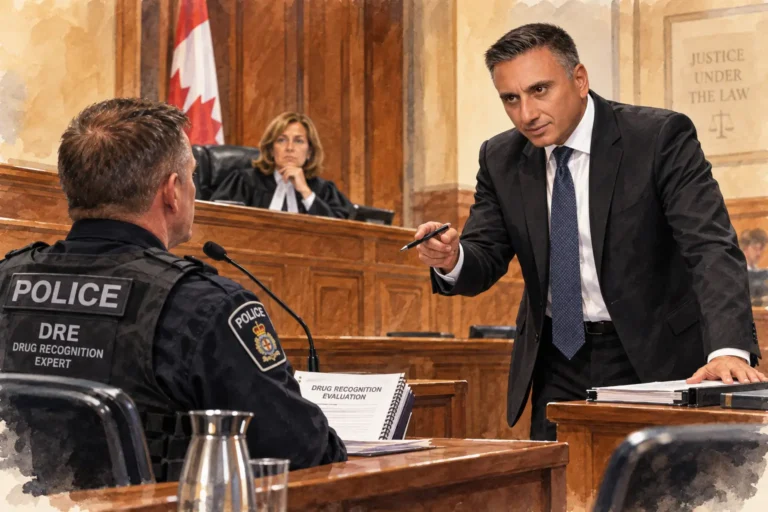
R. v. Bingley & Drug Recognition Evidence
The Supreme Court of Canada on challenging DRE evidence in drug-impaired driving cases.
R. v. Bingley, 2017 SCC 12, is an important Supreme Court of Canada decision about Drug Recognition Expert (DRE) evidence in impaired driving cases. The Court considered when a trained police officer can give expert opinion evidence about whether a drug recognition evaluation indicates impairment.
Nicholas Charitsis is a former Toronto Crown Attorney with more than 25 years of criminal law experience and 350+ five-star Google reviews. His experience fighting impaired driving charges helps him assess police evidence, including DRE evaluations, toxicology evidence and other evidence used to establish impairment.
If you’ve been charged with drug-impaired driving, call Nicholas Charitsis at 416-731-7113 to discuss what happened and how we can help you.
What Happened in R. v. Bingley?
Carson Bingley was observed driving erratically before pulling into a parking lot and striking another vehicle. When police arrived, an officer noticed signs of impairment, including glossy, bloodshot eyes and slurred speech. Bingley passed a roadside alcohol screening test, but police suspected that his ability to drive was impaired by drugs.
A Drug Recognition Expert (DRE) conducted a 12-step drug recognition evaluation at the police station. During the evaluation, Bingley admitted that he had smoked marijuana and taken Xanax. The DRE concluded that he was impaired by a drug and ordered a urine sample. Testing later revealed cannabis, cocaine and alprazolam.
The important legal issue became whether the DRE could give expert opinion evidence about the results of the drug recognition evaluation without a separate hearing to establish the officer’s expertise.
The case eventually reached the Supreme Court of Canada, which had to decide how DRE opinion evidence should be treated in a criminal trial.
Relevant Case Law:
R. v. Bingley — Supreme Court of Canada ([2017] 1 S.C.R. 170)
View the full decision — Supreme Court of Canada (Supreme Court of Canada)
What Did the Supreme Court Decide?
The Supreme Court of Canada ruled that a properly certified Drug Recognition Expert has specialized expertise to conduct the prescribed drug recognition evaluation and give an opinion about whether the evaluation indicates drug impairment.
The Court found that a separate hearing was not required in Bingley’s case to establish the DRE’s expertise before the officer gave this opinion evidence. The Criminal Code of Canada created a specific framework for trained and certified evaluating officers.
However, the Court placed an important limit on this evidence. A DRE’s opinion does not decide whether the accused was actually driving while impaired by a drug or even care and control. That remains a question for the judge to decide after considering all of the evidence.
The DRE’s conclusions can also be challenged by the defence. The officer can be cross-examined about how the evaluation was performed, the observations made and the conclusions reached.
Can a Drug Recognition Expert Be Challenged?
Yes. The Supreme Court made it clear that the opinion of a Drug Recognition Expert is not conclusive. The judge must still decide how much weight to give the officer’s opinion after considering all of the evidence.
The defence may challenge DRE evidence by examining:
- Whether the officer properly followed their DRE training
- How the drug recognition evaluation was conducted
- The observations and conclusions made by the officer
- Whether the officer’s conclusions were supported by the evidence
- Bodily sample and toxicology evidence
- Evidence from other witnesses
- Evidence from an independent expert
Cross-examination can also expose problems with the DRE’s reasoning, possible bias or conclusions that are not supported by what the officer actually observed.
The important point from R. v. Bingley is that being qualified as a Drug Recognition Expert does not make the officer’s opinion automatically correct. The defence can challenge the evidence, and the judge ultimately decides what weight it deserves.
Why R. v. Bingley Matters to the Defence
R. v. Bingley does not mean that a Drug Recognition Expert’s opinion proves that an accused was impaired by drugs. The DRE provides an expert opinion based on the evaluation, but the Crown Attorney must still prove the impaired driving charge beyond a reasonable doubt.
As criminal defence lawyers we’ll examine the DRE evidence together with the rest of the case. This may include the officer’s observations, video evidence, statements made by the accused, toxicology results and evidence from other witnesses.
Where necessary, our defence team may also obtain an independent expert opinion. The Supreme Court specifically recognized that other expert evidence may be used to challenge or refute the conclusions reached by a DRE.
The issue is not simply whether the police officer was qualified as a DRE. The court must ultimately decide whether the evidence proves that the accused’s ability to drive was impaired by a drug.
Drug Recognition Evidence and Your Defence
Drug Recognition Expert evidence can be an important part of a drug-impaired driving case, but the officer’s opinion is not the final word. The evidence must be considered together with the toxicology results, police observations and the rest of the Crown Attorney’s case.
Nicholas Charitsis has more than 25 years of criminal law experience and is a former Crown Attorney. He can review how the DRE evaluation was conducted, identify weaknesses in the police evidence and determine whether an independent expert should be consulted.
If you’ve been charged with drug-impaired driving, call Nicholas Charitsis at 416-731-7113 to discuss what happened and how we can help you.
Frequently Asked Questions
What Is a Drug Recognition Expert in Canada?
A Drug Recognition Expert (DRE) is a police officer with specialized training in evaluating suspected drug impairment. The officer conducts a structured drug recognition evaluation and may give an opinion about whether the evaluation indicates impairment by a drug. In R. v. Bingley, the Supreme Court of Canada considered how this type of expert opinion evidence can be used in court.
Can Our Defence Lawyers Challenge a Drug Recognition Expert’s Opinion?
Yes. Our defence lawyers can cross-examine the DRE about how the evaluation was performed, whether the officer followed their training, the observations made and how the officer reached their conclusions. Toxicology results, other witnesses and independent expert evidence may also be used to challenge the DRE’s opinion.
Does a DRE Opinion Prove Drug-Impaired Driving?
No. A DRE’s opinion is evidence, but it does not automatically prove that you were driving while impaired by a drug. The judge must consider the DRE’s opinion together with the other evidence and decide whether the Crown Attorney has proven the charge beyond a reasonable doubt.
Can We Hire an Expert to Challenge the Police DRE Evidence?
Yes. Depending on the evidence, we may consult a toxicologist or another qualified expert to independently review the scientific evidence and the conclusions reached by the police. An independent expert may identify weaknesses in the Crown’s evidence, help us prepare our cross-examination or, where appropriate, testify for the defence.
What Will We Review in a Drug-Impaired Driving Case?
We review the complete police investigation rather than relying only on the DRE’s final opinion. This can include the DRE evaluation, police notes, video evidence, your statements, driving observations, toxicology results and whether the officer followed the required evaluation procedures. Problems or inconsistencies in this evidence may affect how much weight the court gives the DRE’s opinion.